
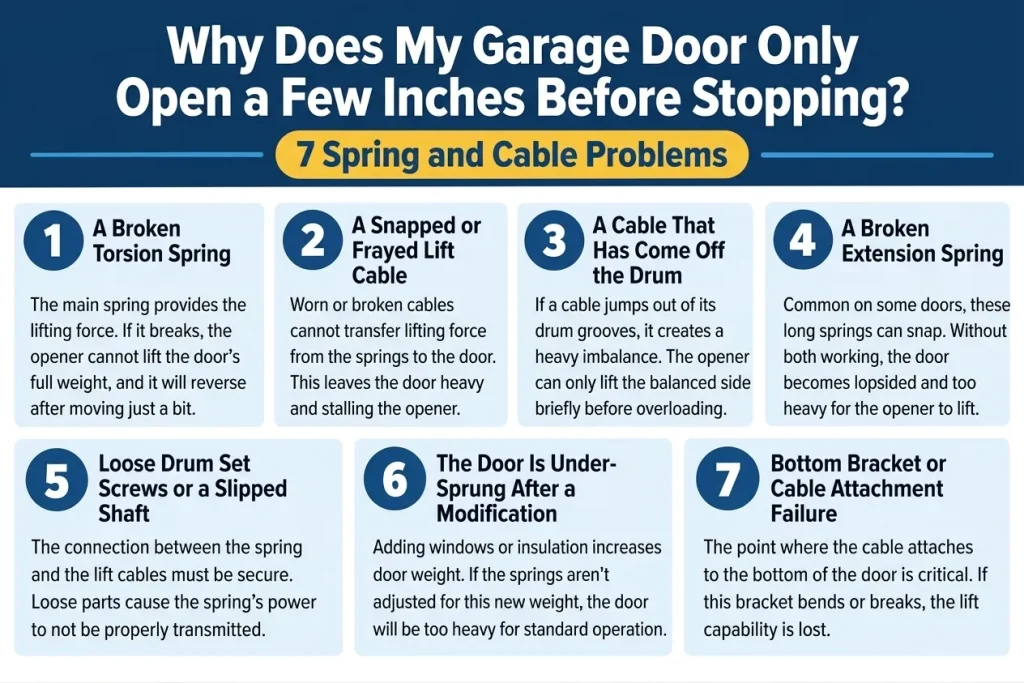
A garage door that rises a few inches and stops is almost never an opener problem. It is the opener telling you the door has become too heavy to lift, which in nearly every case means a spring has broken or a lift cable has failed. The springs carry the weight of the door, not the motor, so when a spring goes, the opener is suddenly asked to lift 150 to 400 pounds it was never built to move. It travels a few inches, senses the resistance, and stops. Do not keep pressing the button, do not raise the opener force, and do not try to pull the door up past the stopping point. Springs and cables hold enough stored energy to cause severe injury, and a door in this state can drop without warning.
Key Takeaways
- A few-inch stop is a weight problem, not a settings problem. No opener adjustment will fix it.
- Repeated attempts strip the opener gear and can worsen a partial cable failure into a complete one.
- If one side rises higher than the other, a cable has failed. That is the clearest single diagnostic sign.
- A loud bang from the garage, often overnight or in a cold snap, is the sound of a torsion spring breaking.
- None of the seven causes below is a safe DIY repair. This article helps you identify what happened and describe it accurately, not fix it.
- Park outside and leave the door down until a technician sees it. A door in this condition is not safe to cycle.
For the full picture of everything that can stop a door short, including the opener-side causes that do not apply here, see the master guide: Why Is My Garage Door Not Opening All the Way? 10 Common Causes and How to Fix Them.
1. A Broken Torsion Spring
Symptom: The door lifts a few inches and stops, or does not move at all while the motor runs. The door feels enormously heavy by hand. Often there was a loud bang from the garage beforehand, sometimes overnight.
Most likely cause: Torsion springs sit on a shaft above the door opening and counterbalance the door’s weight. When one breaks, the counterbalance disappears instantly. This is the single most common reason a door stops within the first few inches.
What to do:
- Stop operating the door. Every additional attempt loads the opener gear against a weight it cannot move.
- Look at the spring on the shaft above the door from a safe distance on the ground. A broken torsion spring shows a visible gap of one to two inches in the coil, as if a slice were removed.
- Note whether your system has one spring or two, and photograph the gap if you can do it safely from the floor.
- If a vehicle is trapped inside, read the emergency access steps before touching anything.
The opener’s behavior here is a safety feature working correctly. As Chamberlain’s opener troubleshooting library explains, openers are built to stop when they sense resistance, which is precisely what a broken spring creates. Background on why springs fail when they do is in why garage door springs snap suddenly, and if your car is stuck in the garage right now, start with how do I open my garage door if the spring is broken.
Call a pro: always, and immediately. Torsion springs are wound under extreme tension and require winding bars and technique that cannot be improvised. This is the repair that sends people to the emergency room every year.
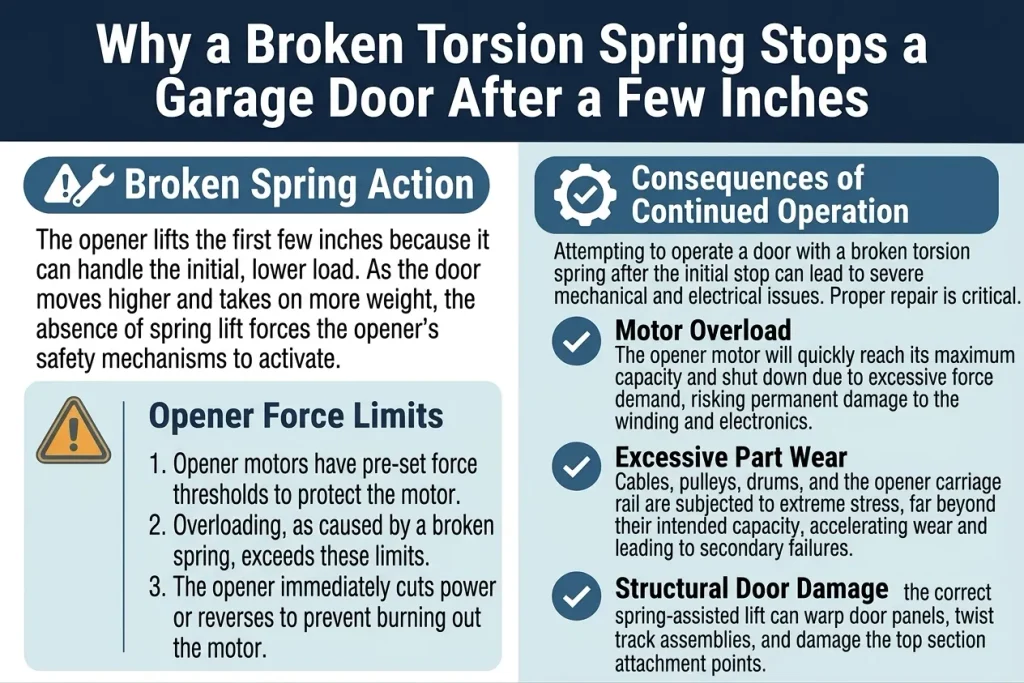
Why a Broken Torsion Spring Stops a Garage Door After a Few Inches
The few-inch distance is not random. The opener applies its rated pull, the door barely moves because nothing is counterbalancing it, and the force limit trips almost immediately. If your door moves two to six inches and quits while the motor sounds like it is straining, the torsion spring should be your first suspicion before anything else on this list.
2. A Snapped or Frayed Lift Cable
Symptom: The door starts up, one side rises and the other does not, and the door wedges in the track at an angle. You may see a loose cable hanging near the drum or coiled on the floor.
Most likely cause: The lift cables transfer spring tension to the bottom of the door. When one snaps, that corner loses all lift. The door goes up crooked, binds against the track, and the opener stops.
What to do:
- Stop operating the door immediately. A crooked door is one cycle away from coming off the track entirely.
- Do not attempt to straighten it by pushing on a corner.
- Look for the failed cable and note which side. Fraying usually starts at the bottom bracket or at the drum.
- Keep people and vehicles out from under the door.
For how the repair is actually performed and why the sequence matters, see the guide to garage door cable replacement.
Call a pro: always. Cables are part of the counterbalance system and carry the same stored energy as the springs. A partly failed cable can release the rest of the way without warning.
Why a Broken Garage Door Cable Makes the Door Open Crooked and Stop
Uneven rise is the most reliable diagnostic sign in this entire article. No opener setting, no motor fault, and no sensor issue can make one side of a door travel further than the other. If you are seeing that, skip every opener theory and call it in. A door that has already jammed at an angle may also reverse hard on the next attempt, which is a separate symptom pattern covered in Why Does My Garage Door Reverse Before It Opens All the Way? 8 Causes Most Homeowners Miss.
3. A Cable That Has Come Off the Drum
Symptom: The door rises a short distance, then stops or jerks to one side. You can see loose, slack cable near a drum at the top corner, with the cable unwound or wrapped over itself.
Most likely cause: Cables wind onto grooved drums at each end of the torsion shaft. If the door is closed onto an obstruction, or if it is forced up manually while the opener is disengaged, the cable can go slack and jump out of its grooves. On the next cycle it binds instead of winding.
What to do:
- Stop operating the door.
- Look at both drums. A healthy drum has cable seated neatly in the grooves. A failed one shows cable crossed over itself or hanging free.
- Check whether something was left in the door’s path recently, since that is the usual trigger.
Rewinding a drum correctly means releasing and resetting spring tension, which is why it sits alongside spring work in how to repair garage door springs and cables.
Call a pro: always. Rewinding a drum requires the spring tension to be managed first, and drums that are reseated under load slip again quickly. This also traces back to setup quality more often than people expect, which is one reason a correct garage door installation sets drum position and cable tension precisely rather than approximately.
Why a Cable Off the Drum Stops a Garage Door in the First Few Inches
Drum failures produce the same few-inch stop as a broken spring but with a different sound. A spring failure is usually silent after the initial bang, while a drum problem often produces a metallic scraping or a snap as the cable binds. Describing which one you heard genuinely speeds up the diagnosis over the phone.
4. A Broken Extension Spring
Symptom: The door lifts a few inches and stops. You can see a long spring running parallel to the horizontal track on one or both sides, and one of them is visibly separated, stretched out, or hanging.
Most likely cause: Extension springs stretch along the horizontal tracks rather than sitting on a shaft. They are common on older doors and on lighter single doors. When one fails, that side loses its counterbalance and the door becomes too heavy for the opener.
What to do:
- Stop operating the door.
- From the floor, look along both horizontal tracks for a separated or deformed spring.
- Check whether a safety cable runs through the inside of each spring. If there is no safety cable, treat the area as dangerous and stay clear of it.
How this system differs from torsion is explained in the role of garage door extension springs, and the warning signs that precede failure are in why worn garage door springs are dangerous.
Call a pro: always, and mention the safety cable. An extension spring without a containment cable can become a projectile when it fails, which is exactly why the industry requires them.
Why a Failed Extension Spring Prevents a Garage Door From Opening Fully
Extension spring failures are often more visually obvious than torsion failures, because the spring is out in the open along the track rather than tucked above the door. If you can see a spring hanging loose or stretched to twice its neighbor’s length, you have found your answer.
5. Loose Drum Set Screws or a Slipped Shaft
Symptom: The door starts up, one side lags, and there is a sudden slip or clunk. It may work intermittently, which is what makes people blame the opener.
Most likely cause: The cable drums are locked to the torsion shaft by set screws. If those loosen, the drum slips on the shaft under load. Tension is lost on that side and the door binds.
What to do:
- Stop operating the door.
- Note whether the failure is intermittent rather than constant, and whether you hear a slip or clunk at the moment it stops.
- Do not attempt to tighten a set screw. The drum is under full spring load, and loosening or tightening it without controlling that load is dangerous.
This is the cause most often misdiagnosed as an opener fault, because the intermittent pattern mimics a marginal force setting. If your door actually stops at the midpoint rather than in the first few inches, and the stop is clean rather than crooked, the opener-side checks in Why Does My Garage Door Stop Halfway When Opening? 6 Travel Limit and Force Settings to Check First are the right starting point instead.
Call a pro: always. Correcting drum position means resetting spring tension first.
Why a Slipped Cable Drum Causes a Garage Door to Stop After a Few Inches
The tell here is inconsistency. A broken spring fails the same way every time. A slipping drum may let the door open normally once, then fail on the next cycle, then work again. Homeowners often spend a week adjusting a garage door opener before anyone looks at the drums, because intermittent faults feel electronic.
6. The Door Is Under-Sprung After a Modification
Symptom: The door has been struggling since something changed. New insulation panels, replacement sections, a heavier door, or a repair where the spring was swapped for a convenient size rather than the correct one.
Most likely cause: Springs are sized to the door’s specific weight, height, and drum diameter. Add weight without re-sizing the spring and the counterbalance is permanently short. The opener is asked to make up the difference on every cycle, and eventually it stops doing so.
What to do:
- Think back to what changed. Insulation kits are the most common culprit we see.
- Do the manual lift test only if the door currently opens fully: close it, disengage the opener, and lift by hand. A correctly sprung door stays put at waist height. An under-sprung door falls.
- Do not compensate by raising opener force. Manufacturer resources including Genie’s owner support resources are clear that force settings are safety limits, not lifting power.
Correct sizing starts with measurement, and how to measure garage door springs explains the four figures that determine it. On commercial doors the same principle extends to the door operator system, which has to be matched to the door’s actual weight rather than its nominal size.
Call a pro: to have the door weighed and the spring re-sized. This is a calculation, not a guess, and the wrong spring shortens the life of everything it touches.
Why an Under-Sprung Garage Door Stops Before Opening Completely
This one develops gradually, which disguises it. The door does not fail the day the insulation goes on. It fails months later when a marginal counterbalance finally crosses the opener’s force threshold, usually on the first genuinely hot afternoon of the summer.
7. Bottom Bracket or Cable Attachment Failure
Symptom: The door lifts unevenly at one bottom corner, or the corner appears to be pulling away from the door. You may see a bracket bent, cracked, or partially detached from the bottom section.
Most likely cause: The bottom brackets anchor the lift cables to the door. Rust, fatigue, or a vehicle impact can crack a bracket or pull its fasteners out of the section. The cable then has nothing solid to pull against.
What to do:
- Stop operating the door and keep everyone clear of the bottom corners.
- Look at both bottom brackets from a safe distance. Bending, cracking, or fasteners backing out are all failures.
- Understand that the bottom bracket is under full cable tension at all times, even with the door closed. Removing a bolt from one is a known cause of serious injury.
Component failures at the bottom of the door are also behind a different and more alarming symptom, covered in what happens when a garage door slams shut due to parts failure.
Call a pro: always, and urgently. If the bottom section itself is damaged or corroded around the bracket, the repair decision may shift toward section replacement or a full garage door replacement, because a bracket is only as strong as the steel it is bolted to.
Why a Damaged Bottom Bracket Stops a Garage Door From Opening
Bracket failures are less common than springs and cables but more dangerous, because they can fail progressively and then suddenly. If a bottom corner looks wrong, treat the door as out of service rather than as something to watch.
Which Component Failed? Quick Diagnostic Table
| What you observe | Most likely component | Safe to DIY? |
| Loud bang, then door barely moves, gap visible in coil above door | Torsion spring | No |
| One side rises, other does not, door wedges at an angle | Lift cable | No |
| Slack cable visible at a top corner drum | Cable off the drum | No |
| Long spring beside the horizontal track is separated or stretched | Extension spring | No |
| Intermittent, with a slip or clunk when it stops | Drum set screws or shaft | No |
| Gradual decline since insulation or new sections were added | Under-sprung door | No |
| Bottom corner bracket bent, cracked, or pulling away | Bottom bracket | No |
| Door stops at the midpoint, cleanly and level, same height each time | Opener travel limit, not a spring | Yes, with care |
| Door is heavy by hand but nothing looks broken | Springs at end of service life | No |
Every row but one says no, and that is not caution for its own sake. Springs, cables, drums, and bottom brackets are a single tensioned system, and disturbing any part of it without controlling the load is what causes the injuries. The warning signs that show up before a failure are worth knowing, and common signs you need garage door spring installation covers them. For how long you should reasonably expect a spring to last, see the average life of garage door springs, and for why this particular repair is worth paying for properly, why professional garage door spring replacement matters.
Leave It Down and Get It Looked At
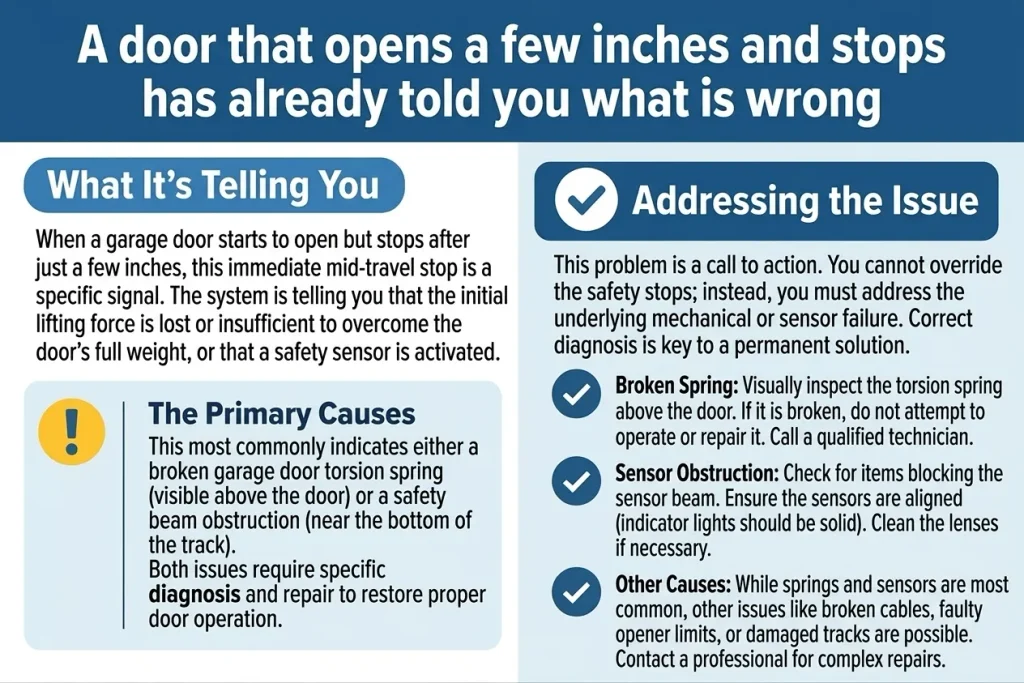
A door that opens a few inches and stops has already told you what is wrong. The counterbalance system has failed, and the opener is refusing to fight it. That refusal is protecting your opener and, more importantly, protecting whoever is standing under the door. The worst outcome here is not the repair cost. It is the person who keeps pressing the button, strips the opener gear, and turns a spring replacement into a spring replacement plus a new opener, or the person who decides to pull the door up by hand and finds out how much energy a failed cable was still holding.
Leave the door down, park outside, and get it diagnosed. If you are anywhere in Richmond, Katy, Sugar Land, Fulshear, Rosenberg, Missouri City, or the surrounding Fort Bend County area, First Call Garage Doors carries the springs, cables, and drums for most residential doors on the truck, which is why this is usually a same-day fix rather than a multi-day wait.
Book your same-day garage door diagnostic or request a free quote.
Frequently Asked Questions
2. I heard a loud bang from the garage last night and now it will not open. What was that?
That is one of the most recognizable calls we get, and it is almost always a torsion spring breaking. The sound is startling enough that people call the police thinking someone hit the house. Springs tend to let go when the door is closed and the spring is under maximum tension, which is why it so often happens overnight or on the first cold morning of the season.
3. Only one spring broke. Do I have to replace both?
We recommend it, and here is the honest reasoning rather than a sales line. Both springs were installed at the same time and have run the same number of cycles. When one reaches the end of its life, the other is typically within months of doing the same. Replacing one means paying for a second service call soon, and it also leaves the door running on a mismatched pair, which wears unevenly. You can decline, and we will tell you plainly what to expect if you do.
4. Is it safe to keep using the opener if the door still opens a few inches?
No, and this is where we push back hardest. Every attempt grinds the opener gear against a load it cannot lift, and with a partly failed cable, every cycle is a chance for the rest of it to let go. Our rule of thumb from the field: once the door stops behaving like a door, stop treating it like one.
5. How long does the repair usually take?
For a standard residential spring or cable replacement, most of our calls are done within an hour or two once the technician is on site, assuming the parts are on the truck. Doors with unusual spring sizes, commercial units, or damage beyond the springs take longer. We will tell you on the phone if we expect it to be the longer kind.
6. Why did my spring only last a few years?
Springs are rated in cycles, not years. A standard spring is often rated around 10,000 cycles, which is roughly seven years at four openings a day but far less in a household where the garage is the main entrance and the door runs eight or ten times daily. High-cycle springs cost more up front and are usually the better value for busy households. We can tell you which you have.
7. Can I buy a spring online and have you install it?
We generally do not, and we would rather explain why than just decline. Spring sizing depends on the door's actual weight, height, and drum diameter, and the specs sold online are frequently wrong for the door they end up on. Installing a mis-sized spring means the door is unsafe and we have no way to warrant the work. We would rather measure and supply the correct part.
8. The door opens a few inches and one side is clearly higher. What does that mean?
That is a cable, essentially every time. Springs failing will make the door heavy, but they do not make one side outrun the other. Stop operating it at that point, because a door sitting crooked in the track is the step right before it comes out of the track altogether.
9. What does a spring or cable repair cost?
It depends on whether the door uses torsion or extension springs, how many springs it has, whether cables and drums also need replacing, and whether you opt for standard or high-cycle springs. Extension spring work generally sits at the lower end of our range and torsion work at the middle. We quote before we start, and we do not begin work you have not approved. Call for current pricing, since steel costs move.
10. Would a new opener fix this?
No, and this is one of the more expensive misunderstandings we run into. The opener is not what lifts your door, the springs are. A more powerful opener paired with a failed spring will simply strain harder and fail sooner, and it removes the safety margin that made the old one stop. Fix the counterbalance first. If the opener is genuinely worn out as well, that is a separate conversation and we will say so.