
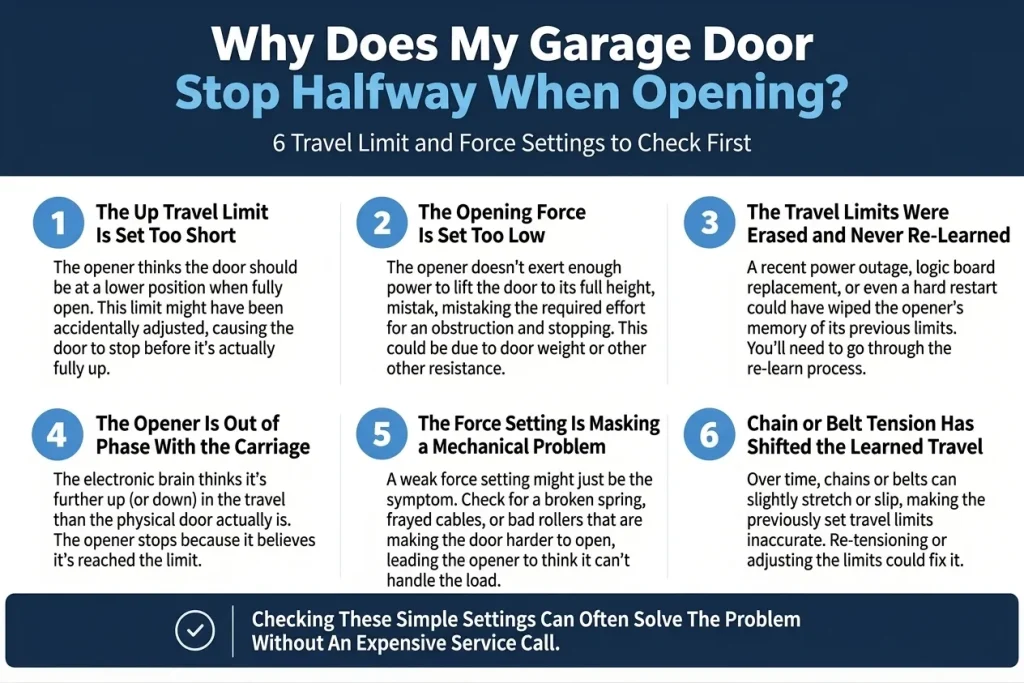
If your garage door stops halfway when opening, the cause is almost always one of two opener settings: the up travel limit, which tells the opener where to stop, or the opening force, which tells it how hard it is allowed to pull. Before touching either one, run the manual lift test. Close the door fully, pull the emergency release, and lift by hand. If the door glides up and stays put on its own, the door is fine and the problem is in your opener settings, which you can usually correct in ten minutes. If the door feels heavy or drops when you let go, stop. No setting will fix that, and raising the force to compensate is how a nuisance becomes a hazard.
Key Takeaways
- A door that stops at the exact same height every time is a travel limit problem. A door that stops at a different height each time is a force problem.
- The manual lift test comes first, always. It tells you whether adjusting settings is appropriate at all.
- Adjust in small increments. Quarter turns on screw-type units, short presses on button-type units.
- Never raise the opening force to push a heavy door through resistance. Force exists to protect people, not to compensate for failing hardware.
- Power interruptions erase or corrupt stored travel limits on many openers, which is why this problem spikes after storm weeks in Fort Bend County.
- After any force change, retest the safety reversal before you consider the job done.
For the full list of reasons a door stops short, including the mechanical causes that settings cannot fix, start with the master guide: Why Is My Garage Door Not Opening All the Way? 10 Common Causes and How to Fix Them.
1. The Up Travel Limit Is Set Too Short
Symptom: The door rises smoothly and parks at the same height every single time. No grinding, no straining, no reversal. It simply stops, as if that were the top.
Most likely cause: The up travel limit is the opener’s definition of “fully open.” If it has drifted, or was set during installation for a different door height, the opener stops exactly where it was told to. Nothing is broken. The opener believes it finished.
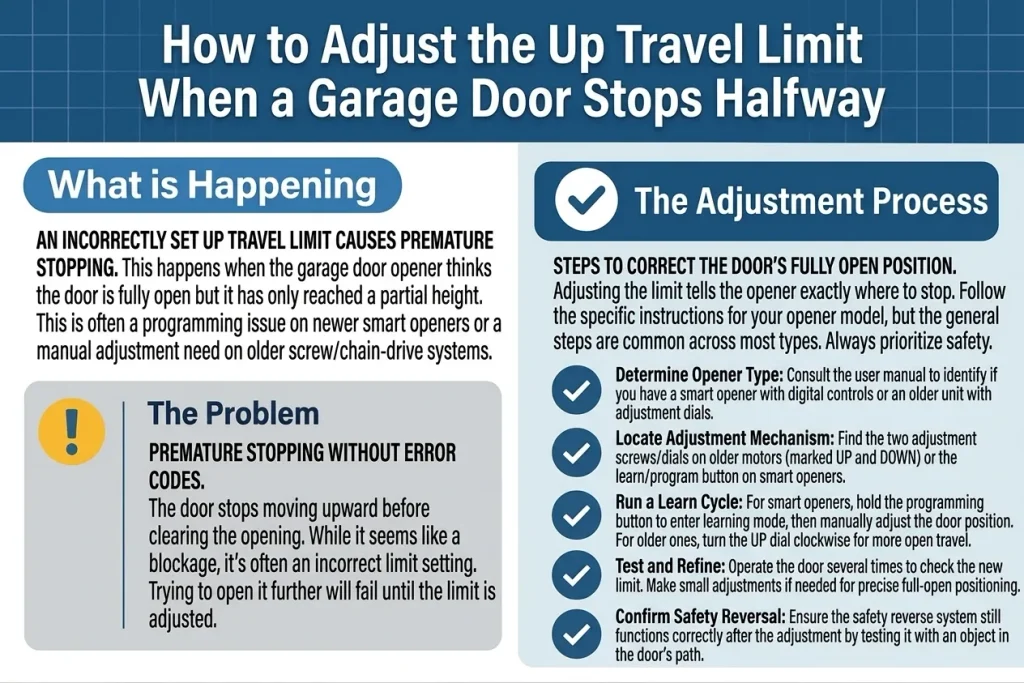
Fix steps:
- Confirm the consistency. Run the door three times and watch where it stops. Identical height each time points squarely at the limit.
- Locate the limit controls on the motor head. Older units use two labeled adjustment screws. Newer units use up and down arrow buttons with a program or set button.
- On screw units, turn the up screw in quarter-turn increments to increase travel. On button units, follow your model’s learn sequence.
- Test after each increment, not after several.
- Stop increasing once the bottom of the door clears your tallest vehicle and the trolley is not hitting the stop bolt at the end of the rail.
Model differences here are larger than most guides admit, so work from your own manual rather than a generic turns-to-inches figure. Our brand-specific walkthrough for LiftMaster units is in adjusting a LiftMaster garage door opener.
Call a pro if: the limit will not hold its setting between cycles, the door overshoots and slams the rail stop, or the adjustment makes the door reverse instead of stopping cleanly.
How to Adjust the Up Travel Limit When a Garage Door Stops Halfway
The most common self-inflicted error we see is the big adjustment. A homeowner turns the up screw two or three full rotations, the trolley drives into the stop bolt, and the opener reads that hard stop as an obstruction. Now the door reverses instead of stopping short, and the original problem looks worse. Quarter turns, test, repeat. It takes five minutes longer and it works.
2. The Opening Force Is Set Too Low
Symptom: The door starts up at normal speed, visibly slows as it climbs, then stops or backs down. The stopping height varies from cycle to cycle, and may change with the weather.
Most likely cause: Force settings cap how hard the opener is allowed to pull. Set too low, the opener interprets ordinary lifting resistance as an obstruction and quits, because that is precisely what the setting is designed to do.
Fix steps:
- Run the manual lift test first. If the door is heavy by hand, stop here and book service.
- Find the up force control. Older units use a dial or screw marked with an upward arrow. Newer units use a programming sequence.
- Increase by one small increment.
- Test. Repeat only if needed.
- Retest the safety reversal afterward by laying a 2×4 flat on the floor in the door’s path and closing the door. It must reverse on contact.
Screw-drive openers behave differently from chain and belt units here, and our guide on the Genie screw drive closing force adjustment covers that variation.
Call a pro if: the door only completes its travel after a large force increase, or the required force keeps creeping up over weeks. That is the opener compensating for a mechanical problem, not a settings problem.
Why Low Opening Force Makes a Garage Door Stop Midway
Force and travel limits produce similar symptoms, which is why people chase the wrong one for an afternoon. The distinguishing tell is consistency: a limit problem stops the door at an identical height, while a force problem produces a variable stopping point, usually preceded by a visible slowdown. If your door does not just stop but actively backs down, the diagnosis shifts again, and the full breakdown is in Why Does My Garage Door Reverse Before It Opens All the Way? 8 Causes Most Homeowners Miss.
3. The Travel Limits Were Erased and Never Re-Learned
Symptom: The door worked fine, then abruptly started stopping short, often after a power outage, a surge, a breaker trip, or after someone pressed buttons on the motor head. Lights may flash or a buzzer may sound during operation.
Most likely cause: Many openers store travel limits electronically. A power interruption can wipe or corrupt them. The opener falls back to a default or partial value and stops early because it no longer knows the real range of travel.
Fix steps:
- Look at the opener’s LED indicators while you run the door. Flashing patterns and beep counts are diagnostic codes, not decoration.
- Cross reference the pattern against your manual before adjusting anything.
- If the limits were erased, do a full re-learn rather than nudging a single screw. Most units want you to set the down limit first, then the up limit.
- Run the door through several complete cycles to confirm the new limits hold.
If your unit is showing lights but not moving as expected, what it means when the garage door opener light flashes but nothing happens walks through the common patterns.
Call a pro if: the limits refuse to save after a correct re-learn sequence. That usually means the logic board took a surge hit, and no amount of reprogramming will stick.
Why a Power Outage Causes a Garage Door to Stop Halfway When Opening
Entrapment protection and reversal behavior on residential openers are governed by a federal safety rule, published and updated through the Federal Register, where the residential garage door operator standard is issued. One practical consequence of that rule is that when an opener loses confidence in its stored settings, it fails conservatively: it stops early rather than driving blind. A door that quits halfway after a storm is usually a safety system behaving exactly as designed, not a broken unit.
4. The Opener Is Out of Phase With the Carriage
Symptom: The motor runs its full cycle but the door travels only part way, or the trolley reaches the end of the rail while the door is still partly down. The relationship between what the motor does and what the door does no longer makes sense.
Most likely cause: The carriage has been disconnected and reconnected at the wrong point, or the chain has jumped a sprocket tooth. The limits are still set correctly in the opener’s memory, but they now reference a carriage position that does not match the door’s real position.
Fix steps:
- Watch the trolley rather than the door. If the trolley completes its travel and the door does not follow, the carriage relationship is the issue.
- Close the door fully before reconnecting an emergency release. Reconnecting mid-travel is how most out-of-phase conditions start.
- Once reconnected at the correct point, re-learn both limits from scratch.
Knowing which part you are looking at helps, and the parts of a garage door opener labels the carriage, rail, trolley, and sprocket.
Call a pro if: the chain has jumped the sprocket, the rail is bowed, or the carriage will not re-engage. This also shows up frequently on units that were never commissioned correctly, which is one reason a proper garage door installation sets and verifies limits as part of the job rather than leaving them at factory defaults. On commercial units the same logic applies to the door operator system, where an operator sized incorrectly for the door will never complete its travel no matter how the limits are programmed.
Why an Out-of-Phase Carriage Stops a Garage Door Partway Up
This one frustrates people because the settings look correct and the opener sounds healthy. The giveaway is the mismatch between motor runtime and door movement. If the motor runs for its normal duration and the door covers half the distance, stop adjusting limits. You are correcting the wrong variable.
5. The Force Setting Is Masking a Mechanical Problem
Symptom: The door stopped halfway, someone raised the force, and it worked again. A few weeks later it is stopping halfway again, and the force has to go up once more.
Most likely cause: The door is getting harder to lift. Springs losing tension, rollers seizing, cables stretching, and dry bearings all increase the load. Raising force each time buys a few weeks and hides a failure that is still progressing.
Fix steps: There is no safe setting-based fix here. Return the force to a reasonable level and get the door hardware inspected.
Call a pro if: you have raised the force more than once for the same symptom. That pattern is the clearest single indicator that the problem is in the door, not the opener.
Why You Should Never Raise Opener Force to Fix a Halfway Stop
The industry guidance from the Door and Access Systems Manufacturers Association is consistent on this point: force and sensitivity adjustments exist as safety limits, and a door that needs excessive force is an unsafe door, not a mis-set one. The force setting is what stops the door from crushing a bicycle, a pet, or a child. Every increment you add to defeat a mechanical problem is an increment removed from that protection. If your door is stopping within the first foot or two of travel rather than at the midpoint, the likely cause moves into the spring and cable system entirely, covered in Why Does My Garage Door Only Open a Few Inches Before Stopping? 7 Spring and Cable Problems Behind It.
6. Chain or Belt Tension Has Shifted the Learned Travel
Symptom: The door has gradually started stopping a little shorter over months. You may hear the chain slapping the rail, or see it sagging well below the rail when the door is closed.
Most likely cause: A stretched chain or belt changes how far the carriage actually moves for a given amount of motor rotation. The stored limits stay the same, but the physical result drifts. Slack also causes the opener to read jerky resistance as an obstruction.
Fix steps:
- With the door closed, look at the chain or belt against the rail. Manufacturers specify a sag figure, typically a small fraction of an inch above the rail base.
- Tension to your model’s spec using the turnbuckle or adjustment nut.
- Do not overtighten. Excess tension wears the sprocket and the motor bearings faster than slack does.
- Re-learn the travel limits after tensioning, because the reference point has moved.
Catching drift early is exactly what routine service is for, and garage door opener checkups that help prevent bigger problems covers what a checkup includes.
Call a pro if: the chain has stretched past the adjustment range, the sprocket teeth are visibly worn, or the unit grinds after tensioning. On an opener past twelve to fifteen years, a new garage door opener often costs less than a gear and sprocket rebuild plus labor, and it brings current safety features with a fresh warranty. If the door itself is also aging out, a full garage door replacement resets the whole system rather than pairing a new opener with tired hardware.
How Chain Tension Affects Where a Garage Door Stops Opening
Tension problems are the slowest of the six to develop, which is why homeowners rarely connect them to the symptom. If your door has lost an inch or two of travel per season rather than failing suddenly, tension drift belongs at the top of your list.
Which Setting Is Your Problem? Quick Diagnostic Table
| Travel limit problem | Force problem | Mechanical problem | |
| Where it stops | Same height every cycle | Varies cycle to cycle | Varies, often at one physical point |
| Sound | Normal, stops cleanly | Motor slows before stopping | Grinding, squealing, or slapping |
| Does it reverse? | Usually no, it just parks | Often yes | Often yes, sometimes hard |
| Manual lift test | Door glides and holds | Door glides and holds | Door is heavy, drags, or drops |
| Weather sensitive? | No | Yes, worse in summer heat | Yes |
| Safe to adjust yourself? | Yes, in small increments | Yes, in small increments, with reversal retest | No |
| What to do | Re-learn or nudge the up limit | Raise force slightly, once | Stop using the door and book service |
The honest boundary on DIY here is narrower than the internet suggests, and whether you can service your own garage door lays out where it sits. If your diagnosis lands on the opener itself rather than the settings, whether it is cheaper to repair or replace a garage door opener covers the decision.
Get the Setting Right, or Find Out Why It Will Not Hold
Travel limits and force are genuinely homeowner-adjustable, and a good share of halfway-stop calls end with a settings change that takes minutes. The part worth taking seriously is the boundary. If the manual lift test says the door is heavy, or if the force has to keep going up to get the same result, you are no longer adjusting an opener. You are compensating for hardware that is failing, and the setting you are changing is the one protecting your family from a 200 pound door.
If your door is stopping halfway anywhere in Richmond, Katy, Sugar Land, Fulshear, Rosenberg, Missouri City, or the surrounding Fort Bend County area, First Call Garage Doors can tell you in one visit whether it is a five minute adjustment or something that needs parts, and get it corrected the same day in most cases.
Book your same-day garage door diagnostic or request a free quote.
Frequently Asked Questions
2. I adjusted the limit and now the door reverses at the top. What did I do wrong?
You went too far, and the trolley is hitting the stop bolt at the end of the rail. The opener reads that impact as an obstruction and reverses, which is correct behavior on an incorrect setting. Back the adjustment off until the door stops just short of the hard stop. This is one of our most common follow-up calls after a homeowner attempt, and it is an easy correction.
3. My opener has buttons instead of screws. Where are the limits?
Newer units replaced mechanical limit switches with an electronic learn sequence, usually up and down arrow buttons plus a set or program button on the motor head. The buttons are often behind a light cover or a small panel. The sequence differs enough between models that guessing tends to erase the settings rather than change them, so pull the manual for your model number first.
4. Will adjusting the force or limits void my warranty?
Limit and force adjustment is documented homeowner maintenance in nearly every manual we see, so no. What can create a problem is a claim on a unit damaged by running it at excessive force for a long period. Our rule of thumb from the field: if you are adjusting within the documented range for a normal reason, you are fine. If you are adjusting to force a heavy door open, you are creating the exact damage a warranty will not cover.
5. The door stopped halfway right after a storm knocked our power out. Coincidence?
Almost certainly not. This is one of our most common calls after a storm week. Power interruptions wipe or corrupt stored travel limits on a lot of units, especially older ones and anything without battery backup. Re-learning the limits usually restores it. If the limits will not save after a proper re-learn, the board took a surge hit.
6. How far should my garage door actually open?
Far enough that the bottom of the door clears the tallest vehicle you park under it, with the trolley stopping short of the rail's hard stop. There is no universal height. If you have moved from a sedan to a truck, the door may not have changed at all, you just need more of its travel than you used to.
7. I raised the force and it works now. Am I done?
Only if the door passed the manual lift test first. If it did, yes, run the 2x4 reversal test and you are finished. If you skipped that test, go back and do it. A door that needed more force because it is getting heavy will need more force again in a few weeks, and each round removes protection from the safety system.
8. How often should limits and force need adjusting?
On a healthy system, almost never. Set correctly at installation, they should hold for years. When we see repeated adjustment needs, it is usually telling us something else is drifting: chain stretch, spring fatigue, or a board that is not holding settings reliably. Treat frequent adjustment as a symptom rather than a chore.
9. Is it safe to do this myself on a ladder?
Limit and force adjustment involves reaching the motor head, which is overhead work. Use a stable ladder on level ground, unplug the opener before you touch anything other than the programming buttons, and keep the door path clear. Never make adjustments while someone is operating the door. The adjustment itself is low risk. The ladder and the moving door are where people get hurt.
10. What does a service call for this usually cost?
If it turns out to be limits or force, it typically lands at the low end of our range, roughly the cost of a standard diagnostic visit, since the adjustment itself is quick. If the diagnosis turns up chain stretch, worn rollers, or spring fatigue, the cost moves with the parts involved. We quote before we start and we do not begin work you have not approved. Call for current pricing, since parts costs move.