
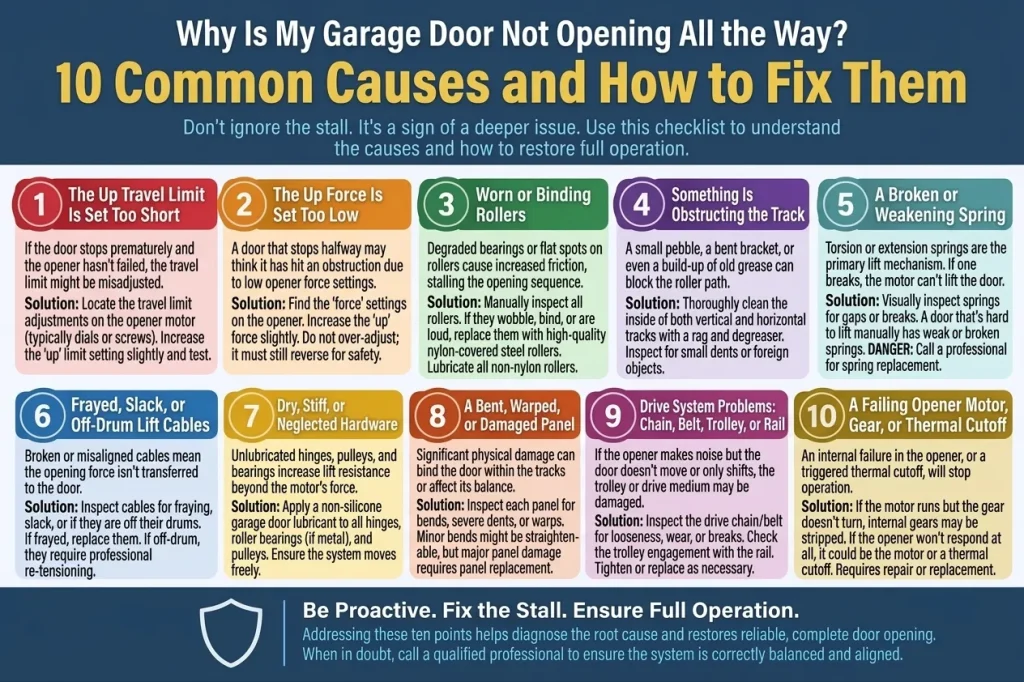
Your garage door most likely stops short because the opener’s up travel limit is set too low, the up force is set too weak, or the door itself has gotten too heavy or too stiff for the opener to finish the lift. Those three account for the large majority of partial-open calls. Start by disconnecting the opener and lifting the door by hand: if it glides up and stays put, the problem is in the opener settings and is often a five minute fix. If it feels heavy, drags, or drops when you let go, the problem is in the door hardware (springs, cables, rollers, or track) and it needs a technician. Do not keep cycling a door that stops short, because every attempt puts strain on the opener gear and the drive train.
Key Takeaways
- A door that stops partway up is usually an opener settings problem, not a broken opener.
- The manual lift test tells you within 60 seconds whether to look at the opener or at the door.
- Photo eye sensors do not stop a door from opening. If someone tells you to clean the sensors for this symptom, they are troubleshooting the wrong direction.
- Springs, cables, and anything under tension are off limits for DIY. These parts store enough energy to cause serious injury.
- Repeated partial opens wear out the opener gear. Stop using the door until it is diagnosed.
- In the Richmond and Fort Bend County heat, summer expansion and dried out lubricant make binding far more common from June through September.
1. The Up Travel Limit Is Set Too Short
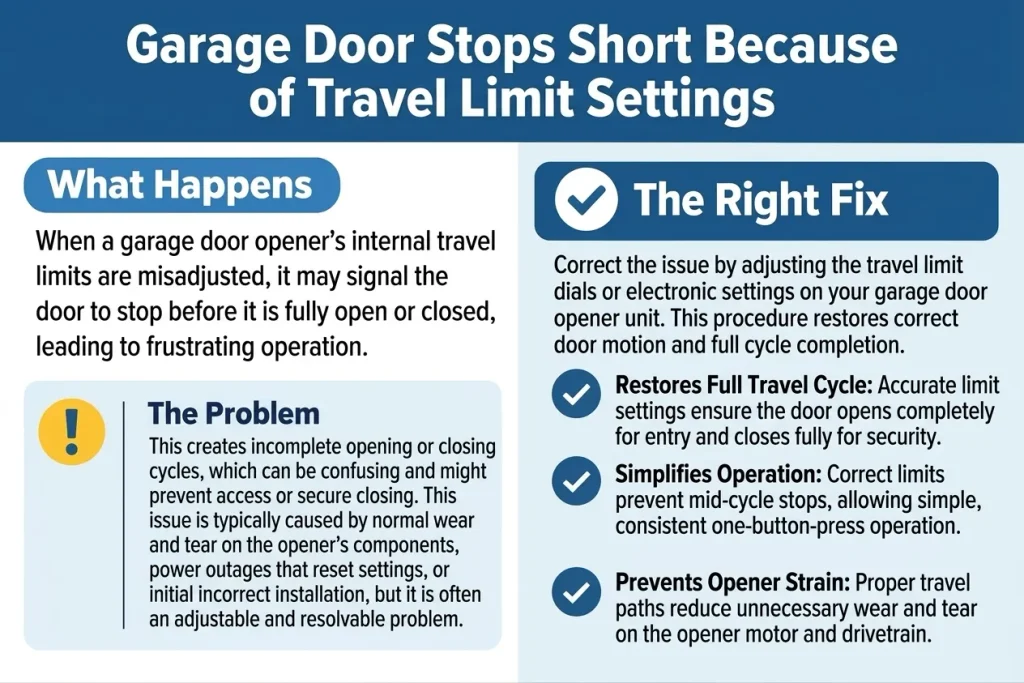
Symptom: The door rises smoothly, then stops at the same height every single time, with no grinding and no reversal. It simply parks early.
Most likely cause: The opener’s up travel limit tells the motor where “fully open” is. If that setting has drifted, or was never set correctly after an installation or a power event, the opener stops exactly where it has been told to stop. It thinks it is finished.
Fix steps:
- Watch the door open and note whether it stops at the identical spot each time. Consistency points to a limit setting.
- Find the limit controls on the motor head. Older units have two labeled screws or dials. Newer units use up and down buttons with a program button.
- Increase the up travel in small increments. Test after each adjustment.
- Stop increasing once the bottom of the door clears your vehicle and the trolley is not slamming into the end of the rail.
Model specifics vary more than most homeowners expect, so work from your own manual rather than a generic number of turns. If you have a LiftMaster or Chamberlain unit, the manufacturer keeps model-by-model instructions in Chamberlain’s garage door opener support library. We also have a brand specific walkthrough in our guide to adjusting a LiftMaster garage door opener.
Call a pro if: the limit will not hold its setting, the door overshoots and hits the rail stop, or adjusting the limit makes the door reverse instead.
How to Fix a Garage Door That Stops Short Because of Travel Limit Settings
Travel limits are the first thing to check and the easiest thing to get wrong. The mistake we see most often is a homeowner increasing the up travel until the trolley bottoms out on the rail end, which creates a hard stop the opener reads as an obstruction. Increase in quarter turns or short button presses, never in large jumps. For the full diagnostic sequence including force settings, see Why Does My Garage Door Stop Halfway When Opening? 6 Travel Limit and Force Settings to Check First.
2. The Up Force Is Set Too Low
Symptom: The door starts up normally, slows as it climbs, then stops or backs down before reaching the top. It may stop at a slightly different height each time.
Most likely cause: Force settings control how hard the opener is allowed to pull. Set too low, the opener interprets normal lifting resistance as an obstruction and quits. This is a safety feature doing its job on a wrong setting.
Fix steps:
- Confirm the door is not actually heavy by doing the manual lift test first. Never raise force to compensate for a failing spring.
- Locate the up force control on the motor head.
- Increase it slightly, one small increment at a time.
- Retest the reversal safety after any force change by placing a 2×4 flat on the floor in the door’s path and closing the door. It must reverse on contact.
The Genie owner resources at The Genie Company’s opener support pages cover the force programming sequence for their models, which differs from the screw adjustments on older units.
Call a pro if: the door only completes its travel after a large force increase. That is the opener compensating for a mechanical problem, and raising force to mask it is how openers burn out and how doors become unsafe.
Why a Garage Door Opens Partway When Opener Force Is Set Too Low
Force and travel limits are separate settings that produce similar symptoms, which is why people chase the wrong one. The distinguishing tell: a travel limit problem stops the door at the same height every time, while a force problem stops it at a variable height and often produces a slowdown just before the stop. If the door is a commercial unit, the sizing of the door operator system matters more than the force dial, because an undersized operator will never finish the lift no matter how the force is set.
3. Worn or Binding Rollers
Symptom: The door climbs in a jerky, stuttering way and stalls, often at the curve where the vertical track turns horizontal. You may hear grinding or squealing.
Most likely cause: Rollers with failed bearings stop rolling and start dragging. The resistance builds as the door climbs, and the opener eventually reads it as an obstruction.
Fix steps:
- With the door closed, look at each roller stem and wheel. Flat spots, wobble, missing bearings, and rust are all failures.
- Check that no roller has worked its way partly out of the track.
- Replace worn rollers as a full set, not individually, so the door tracks evenly.
Our step by step is in how to replace garage door rollers.
Call a pro if: the bottom rollers are involved. The bottom brackets are attached to the lift cables and are under spring tension. Removing one is a common cause of serious injury.
Why Worn Garage Door Rollers Stop a Door From Opening Fully
Rollers are a wear item, and in the Richmond climate they dry out faster than the manufacturer’s schedule assumes. Heat thins whatever lubricant is left, and humidity accelerates corrosion on the stems. A door that opened fine in March and stalls in July is very often a roller and lubrication problem rather than an opener problem. Regular lubrication buys years of roller life, and our guide on how to properly lubricate your garage door covers what to use and what to avoid.
4. Something Is Obstructing the Track
Symptom: The door stops at an inconsistent height, or stops at one specific point and reverses. There may be a visible scrape mark or a bent section of track.
Most likely cause: A dent in the track, a loosened track bracket, stored items leaning against the track, or a bolt that has backed out creates a physical pinch point the door cannot pass.
Fix steps:
- Close the door and sight down both tracks. Look for dents, gaps at the seams, and brackets pulling away from the wall.
- Clear anything stored against or near the tracks, including ladders and shelving.
- Wipe the track interior clean. Do not grease the track itself, because grease collects grit and makes binding worse.
- Snug any obviously loose track bracket bolts.
Call a pro if: the track is bent, separated at a seam, or out of alignment. Straightening a track by hand usually makes the geometry worse. If the door has come out of the track entirely, stop immediately and read why is my garage door off track.
How to Check for Track Obstructions When a Garage Door Will Not Open Fully
Track problems produce the most alarming version of this symptom, because the door often reverses hard rather than stopping gently. That reversal is the opener protecting itself and you. For the full set of causes behind that specific behavior, see Why Does My Garage Door Reverse Before It Opens All the Way? 8 Causes Most Homeowners Miss.
5. A Broken or Weakening Spring
Symptom: The door feels extremely heavy by hand. It may open a short distance and stop, or open unevenly with one side lagging. On a torsion system you may see a visible gap in the coil above the door.
Most likely cause: Springs, not the opener, carry the weight of the door. The opener only guides it. When a spring breaks or loses tension, the opener is suddenly asked to lift 150 to 400 pounds it was never designed to lift, and it stops.
Fix steps: There are none that are safe to do yourself. Stop using the door. Park outside if your vehicle is trapped inside.
Call a pro if: you suspect a spring at all, which is to say always. Garage door springs hold enough stored energy to cause severe injury or death, and the tools and technique are not improvised. If you need to get a vehicle out in the meantime, read how do I open my garage door if the spring is broken before attempting anything.
Why a Failing Garage Door Spring Stops the Door From Opening All the Way
Springs are rated in cycles rather than years, so a household with four daily openings burns through a spring’s life far faster than one with one. Background on lifespan is in the average life of garage door springs and what causes garage door springs to break. If your door is stopping within the first foot or two of travel, the diagnosis narrows considerably, and the full symptom breakdown is in Why Does My Garage Door Only Open a Few Inches Before Stopping? 7 Spring and Cable Problems Behind It.
6. Frayed, Slack, or Off-Drum Lift Cables
Symptom: One side of the door rises faster than the other. The door goes up crooked and wedges. You may see loose cable hanging near a drum.
Most likely cause: The lift cables transfer spring tension to the door. When a cable frays, stretches, or jumps off its drum, the two sides no longer rise together and the door binds in the track.
Fix steps: Visual inspection only. Look at both cables from a safe distance for fraying, kinks, rust, and slack. Note what you see so you can describe it accurately on the phone.
Call a pro if: you see any cable issue at all. Cables are part of the spring system and carry the same stored energy. A cable that is still partly attached can release without warning.
Why Damaged Garage Door Cables Cause a Door to Open Crooked and Stop
A crooked door is the clearest single indicator that the problem is mechanical rather than electronic. No opener setting causes one side to rise ahead of the other. If your door is going up unevenly, skip the opener troubleshooting entirely and book service.
7. Dry, Stiff, or Neglected Hardware
Symptom: The door is noisy, moves in a labored way, and stalls a foot or two short of fully open. It is often worse on hot afternoons and better in the morning.
Most likely cause: Hinges, rollers, and bearing plates that have gone dry create cumulative friction. Add summer thermal expansion and the total resistance crosses the opener’s force threshold partway up.
Fix steps:
- Apply a garage door specific lubricant to hinges, roller stems, bearing plates, and the torsion tube ends.
- Do not lubricate the track surface.
- Wipe away excess so it does not collect dust.
- Run the door several cycles and retest.
Call a pro if: lubrication helps briefly and the stalling returns within days. That pattern usually means a bearing is failing rather than dry.
Why Lack of Lubrication Makes a Garage Door Stop Short in Hot Weather
This is the most seasonal item on the list for Fort Bend County homeowners. A door that has run fine all spring and starts stalling in late June is very often telling you that it is overdue for service rather than broken. A routine tune up catches it early, and what a garage door tune up costs explains what is included.
8. A Bent, Warped, or Damaged Panel
Symptom: The door binds at a specific height, and you can see a section that is bowed, dented, or separating at the stiles. Often follows a vehicle bump.
Most likely cause: A damaged section changes the door’s geometry. Once the panel no longer sits square, the rollers on that section fight the track, and the door wedges.
Fix steps: Document the damage with photos. Do not attempt to bend a panel back into shape, because the steel is already fatigued and reshaping it introduces new stress points.
Call a pro if: the damage is structural, the section is separating, or more than one panel is affected. At that point the decision is a section swap versus a full garage door replacement, and the answer depends on the age of the door, whether matching sections are still manufactured, and the condition of the rest of the system. For a door that is past repair, a proper garage door installation resets the whole system rather than patching one part of it.
Why a Damaged Garage Door Panel Prevents the Door From Opening Completely
Panel damage is the one cause on this list where the repair versus replace math genuinely favors replacement more often than homeowners expect. Older doors frequently have discontinued sections, and mismatched steel gauge between a new section and old ones creates an unbalanced door that fails again.
9. Drive System Problems: Chain, Belt, Trolley, or Rail
Symptom: The motor runs but the door barely moves or stops early. You may hear the chain slapping, or see the trolley stall while the motor keeps turning.
Most likely cause: A loose chain or belt, a trolley that has come out of phase with the rail, or a worn drive sprocket means motor rotation is not translating into door travel. The opener senses the mismatch and stops.
Fix steps:
- Watch the trolley, not the door. If the trolley travels the full rail and the door does not follow, the carriage connection is the problem.
- If the chain sags well below the rail, it needs tensioning to the manufacturer’s spec.
- If the opener runs and nothing moves at all, the emergency release may be disengaged. Reconnect it with the door fully closed.
Call a pro if: the chain has jumped the sprocket, the rail is bowed, or the trolley will not re-engage.
Why a Loose Chain or Trolley Fault Stops a Garage Door Mid-Travel
Drive system faults are also the classic reason a door stops and then reverses rather than simply parking. Resistance anywhere in the drive train reads to the opener as an obstruction. If the door opens a few feet and comes back down, that is the safety system working correctly on a mechanical problem.
10. A Failing Opener Motor, Gear, or Thermal Cutoff
Symptom: The door opens less far each week. The motor sounds strained or grinds. The opener works on the first attempt and refuses on the second and third, then works again an hour later.
Most likely cause: Worn gear and sprocket assemblies, a failing capacitor, or a thermal overload cutting power after the motor overheats. The intermittent pattern (works, fails, works after cooling) is the signature of thermal cutoff.
Fix steps:
- Note whether the failures correlate with heavy use or hot afternoons. That points to thermal cutoff.
- Listen for a grinding sound with no door movement, which usually means a stripped drive gear.
- Check that the opener is on a dedicated, properly grounded outlet.
Call a pro if: the motor grinds without moving the door, the unit trips the breaker, or the opener is more than 12 to 15 years old. At that age, the cost of a gear rebuild plus a service call often approaches a new unit, and a new garage door opener brings current safety features and a fresh warranty. Our breakdown of whether it is cheaper to repair or replace a garage door opener walks through the decision.
Why an Aging Garage Door Opener Stops Opening the Door All the Way
Openers rarely fail all at once. They degrade, and reduced travel is one of the earliest signals. If your opener is also flashing lights or behaving unpredictably, cross reference what it means when the garage door opener light flashes but nothing happens.
DIY-Safe vs. Call a Pro: Quick Reference
| Task | Safe to DIY? | Why |
| Manual lift test (opener disconnected, door closed first) | Yes | No tension components involved. This is the single most useful diagnostic step. |
| Adjusting up travel limit | Yes, with caution | Reversible setting change. Work in small increments and retest. |
| Adjusting up force | Yes, with caution | Reversible, but never raise force to compensate for a heavy door. Retest the 2×4 reversal after any change. |
| Clearing items stored near the track | Yes | No tension components involved. |
| Cleaning the track interior | Yes | Use a cloth. Do not grease the track. |
| Lubricating hinges, rollers, bearing plates | Yes | Routine maintenance. Use garage door lubricant, not general purpose oil. |
| Tightening a visibly loose track bracket bolt | Borderline | Fine if it is a simple snug. Stop if the track is bent or misaligned. |
| Replacing top and center rollers | Borderline | Doable with care. Bottom rollers are not, because the bottom brackets are under cable tension. |
| Straightening a bent track | No | Reshaping fatigued steel creates new failure points and misaligns the door. |
| Anything involving springs | No | Springs store enough energy to cause severe injury or death. |
| Anything involving lift cables or bottom brackets | No | Same stored energy as the spring system. |
| Repairing or replacing a damaged panel | No | Requires door disassembly under tension and correct section matching. |
| Opener gear, sprocket, or capacitor replacement | No | Electrical and mechanical work inside a live unit. |
Get It Diagnosed Before It Gets Worse
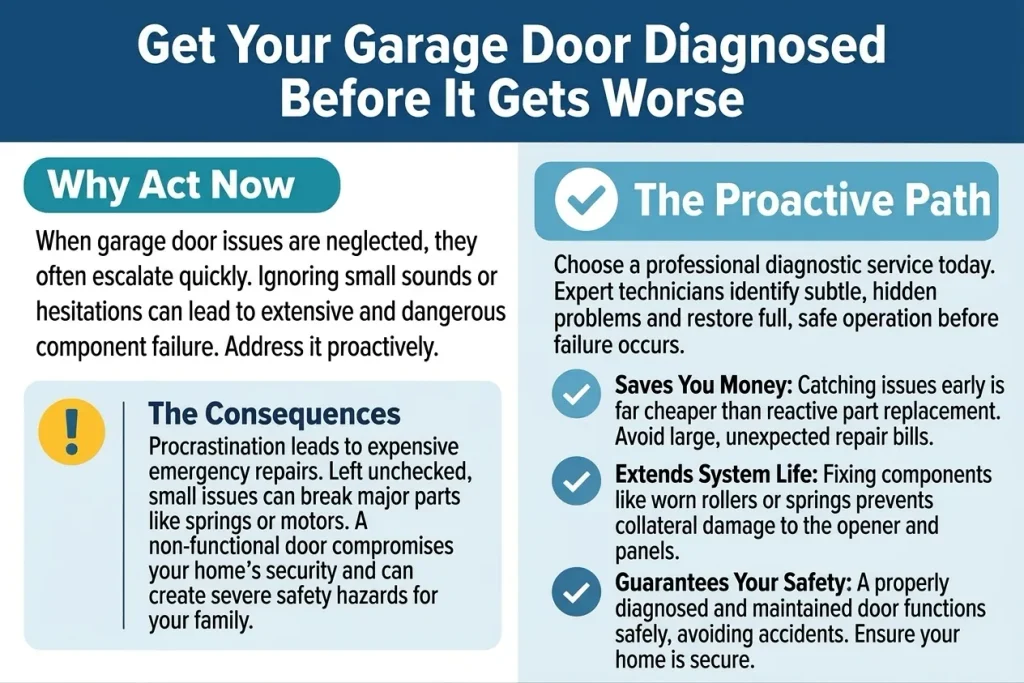
A garage door that stops short is giving you early warning. The opener settings that cause it are quick to correct, and the mechanical causes behind it (springs nearing end of life, cables beginning to fray, rollers seizing) are far cheaper and far safer to address now than after a failure. The one thing not to do is keep cycling the door and hoping, because every strained attempt shortens the life of the opener gear and can turn a repair into a replacement.
If your door is stopping short anywhere in Richmond, Katy, Sugar Land, Fulshear, Rosenberg, Missouri City, or the surrounding Fort Bend County area, First Call Garage Doors can diagnose it properly, tell you honestly whether it is a five minute adjustment or a hardware failure, and get it fixed the same day in most cases.
Book your same-day garage door diagnostic or request a free quote.
Frequently Asked Questions
2. Can I keep using the door if it only opens partway?
We would rather you did not. Our rule of thumb from the field is that a door telling you something is wrong will keep telling you louder. Every cycle where the opener strains against resistance wears the drive gear, and if the underlying cause is a weakening spring, continuing to run it is how a manageable repair becomes a door that drops. If your vehicle is not trapped, leave the door down until it is looked at.
3. Does a door that only opens partway mean the springs are going out?
Not necessarily, and this is where the manual lift test earns its keep. Disconnect the opener with the door fully closed and lift by hand. If it glides and holds position at waist height, your springs are fine and the problem is in the opener settings. If it fights you or drops, the spring system is the suspect. That one test sorts the majority of these calls before we even arrive.
4. Why does my door open fine in the morning and stop short in the afternoon?
That pattern is common here from roughly June through September. Two things are usually stacking: metal components expand in the afternoon heat, and any lubricant that has dried out stops compensating for the added friction. Thermal cutoff on an older motor produces a similar pattern. The heat is not causing a new problem so much as exposing one that was already marginal.
5. My remote works fine, so the remote is not the issue, right?
Correct. If the door responds and begins moving, the remote, the receiver, and the signal path are all working. The problem is downstream of that, in the travel settings or the door hardware. Remote faults look different, and we cover those separately in our remote troubleshooting material.
6. The sensors are clean. Why is the door still not opening fully?
Photo eye sensors only govern the closing cycle. They are designed to stop a door from closing on something, and they have no effect on opening. If someone has you cleaning sensors for a door that will not open all the way, they are troubleshooting the wrong direction. It is an easy assumption to make, and we hear it several times a month.
7. Is this a repair or do I need a whole new opener?
It depends almost entirely on the opener's age and what specifically failed. Settings, chain tension, and most sensor and wiring issues are straightforward repairs at any age. A stripped drive gear or a failing logic board on a unit past twelve to fifteen years is usually where we start recommending replacement, because the repair cost plus the labor lands close to a new unit that carries a warranty and current safety features. We will tell you which side of that line you are on before we do anything.
8. What does it cost to fix a garage door that will not open all the way?
It spans a wide range, because the causes do. A travel limit or force adjustment caught during a standard service call sits at the low end, roughly the cost of a basic diagnostic visit. Roller and hardware replacement sits in the middle. Spring replacement and opener replacement are the higher end. We quote before we start, and we do not begin work you have not approved. Call for current pricing, since parts costs move.
9. Can I adjust the travel limits myself without causing a problem?
Yes, within reason. Travel limits and force are reversible settings, and homeowners adjust them successfully all the time. Two cautions from experience. Work in small increments, because large jumps are how people end up with a trolley hammering the rail stop. And never raise the force setting to push a heavy door through resistance, because that defeats a safety system that exists to stop the door from crushing something. After any force change, run the 2x4 reversal test.
10. Why does it only happen sometimes?
Intermittent faults usually point to one of three things: thermal cutoff on a motor that needs to cool between cycles, a marginal force setting that is only crossed when conditions add friction, or a connection that is loosening and reseating. Intermittent does not mean minor. In our experience it more often means early, which is the best time to catch it.