
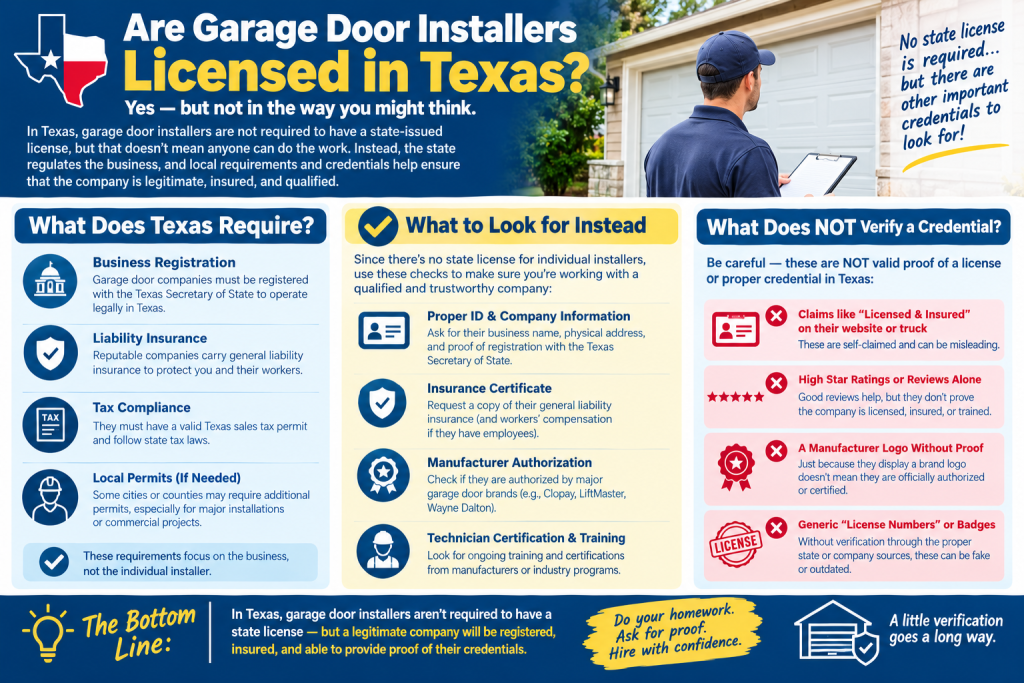
No. Texas does not issue a state license for garage door installation or repair. There is no state trade license, no state board, and no license number to look up, which means any company advertising itself as a “licensed garage door installer” in Texas is referring to something else, usually a city business registration. This is not a loophole and it does not make the work illegal. It does mean the burden of vetting falls entirely on you. The six credentials below are the ones that actually exist in Texas, and every one of them can be verified in a few minutes before a technician arrives.
Key Takeaways
- Texas licenses electricians, plumbers, and HVAC technicians through TDLR, but garage door installers are not on that list.
- The one place licensing genuinely applies is electrical work, so any new opener circuit must be run by a licensed electrician.
- Texas does not require private employers to carry workers’ compensation, which makes that question more important here than in most states.
- Business registration is public and free to check through the Texas Comptroller’s Taxable Entity Search.
- Permits are set locally, not statewide, so the answer for Richmond and Fort Bend County comes from the city or county building department.
- “Licensed and insured” in an ad is a marketing phrase in Texas, not a verifiable credential. Ask which body issued the license.
Why There Is No Texas Garage Door License
Texas regulates trades where a mistake creates a public hazard that inspectors can systematically catch: electrical, plumbing, HVAC, elevators. Garage doors fall outside that framework, the same way general contracting and most remodeling work does. The state has never created a garage door specialty license, and no legislation currently requires one.
The practical effect is that anyone can buy a truck, print a magnet, and start replacing springs in Richmond tomorrow. Most companies doing that are ordinary small operators who are perfectly competent. A minority are not, and the absence of a licensing filter is exactly why garage door work attracts the scam operations the industry has been warning about for years, documented in the International Door Association’s scam awareness resources.
So the question worth asking is not “are you licensed.” It is “what can you show me.” Here is what to ask for, in the order that catches the most problems.
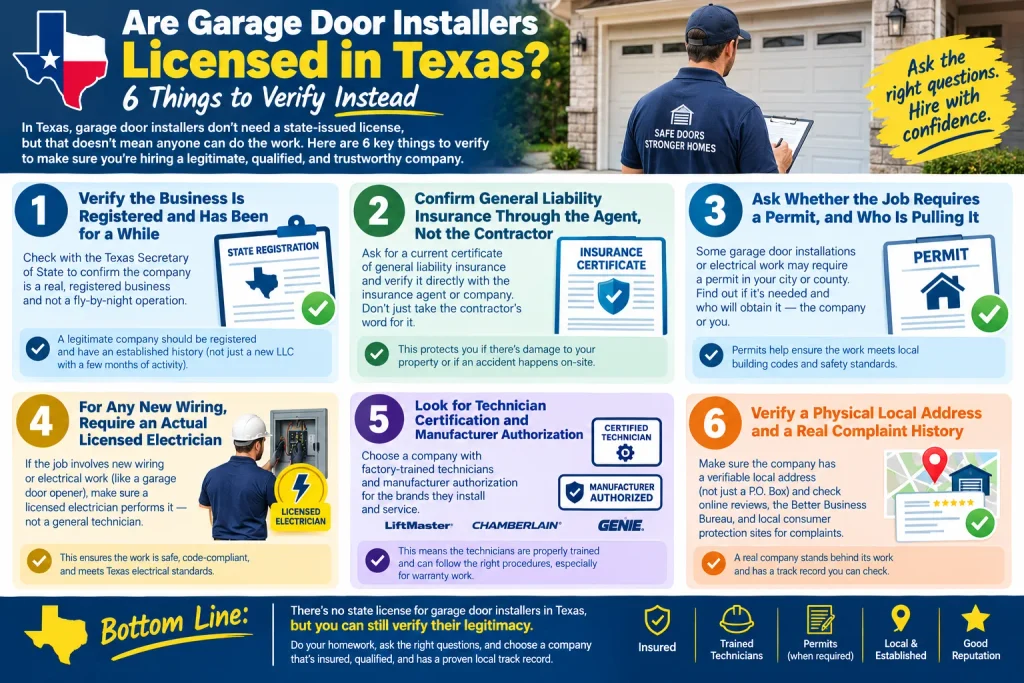
1. Verify the Business Is Registered and Has Been for a While
Start with the Texas Comptroller’s Taxable Entity Search. It is free, public, and takes about a minute. Enter the company’s legal name and confirm three things: the entity exists, its status is active, and its registration date is not from last month.
This single check filters out the largest category of garage door fraud, which is not a bad technician but a lead-generation front. The pattern is a national operation that buys a local phone number, builds a local-looking website, and sells your call to whichever subcontractor bids highest. There is often no Texas entity behind it at all. If the legal name on the website does not appear in the state’s own records, stop there.
How to check if a garage door installer is a registered business in Texas
Search the legal business name, not the brand name, in the Comptroller’s entity search, then confirm the registration date against how long they claim to have served the area. A company that says “serving Richmond since 2015” and registered in Texas eight months ago is telling you two incompatible things.
Call a pro if: you cannot find any entity record and the company will not give you a legal business name. That is disqualifying on its own.
2. Confirm General Liability Insurance Through the Agent, Not the Contractor
Insurance is what replaces licensing as your real protection in Texas. A garage door is a several-hundred-pound assembly bolted to your home’s framing, and the failure modes involve your car, your walls, and occasionally your foundation anchors. General liability covers that damage.
Do not accept a certificate the contractor emails you. Ask for the insurance agent’s name and phone number, call the agent, and ask whether the policy is active today. Certificates are trivially easy to alter and an expired policy looks identical to a current one on a scan. While you have the agent on the phone, ask about workers’ compensation separately, because Texas is one of the few states where private employers are not required to carry it. Plenty of legitimate small shops go without. You just want to know before someone is on a ladder in your garage.
How to verify a garage door company’s insurance in Texas
Get the agent’s direct contact information, confirm the policy is current, and ask that your address be listed as the job site. The full list of coverage terms worth confirming is in Is Your Garage Door Company Actually Insured? 7 Coverage Terms to Confirm.
Call a pro if: the job is spring replacement. Torsion springs hold enough stored energy to cause serious injury, which is why worn springs are genuinely dangerous and why an uninsured technician is the worst possible bet on that specific job.
3. Ask Whether the Job Requires a Permit, and Who Is Pulling It
Permitting is local in Texas, not statewide. Richmond and Fort Bend County set their own rules, and requirements differ between a repair, a full door replacement, and an opener install that needs new wiring. The company should be able to tell you immediately which category your job falls into.
Call your city or county building department, give them the company name and a description of the work, and ask two questions: does this require a permit, and is this business permitted to pull one here. A permit is not bureaucratic friction, it puts a municipal inspector between you and a bad install at no additional cost to you. A contractor who actively discourages you from pulling one is protecting something.
Do you need a permit for garage door installation in Richmond, TX
Confirm with the local building department before work starts, and get the permit responsibility written into the estimate. This matters most on full replacements, so it is worth reading what to expect from a garage door installation in Richmond, TX before you schedule a garage door installation.
Call a pro if: the work changes the opening size, alters framing, or adds a circuit. Those are the jobs where inspection exists for a reason.
4. For Any New Wiring, Require an Actual Licensed Electrician
This is the one place where Texas licensing applies directly, and it is the check homeowners skip most often. Plugging an opener into an existing outlet is not electrical work. Running a new dedicated circuit, adding an outlet in the ceiling, or hardwiring a unit is, and it requires a licensed electrician under Texas law. TDLR maintains a public license search, so this credential you can genuinely verify by number.
Ask directly: is the wiring part of this job being done by a licensed electrician, and can I have the license number. A garage door technician who casually offers to “run a line” for you is doing unlicensed electrical work in your ceiling, and your homeowner’s insurance may take a position on that later.
Who is licensed to wire a garage door opener in Texas
Any new circuit requires a TDLR-licensed electrician whose license number you can verify online. Existing-outlet installs do not. If you want to understand what the wiring actually involves, our guide on how to wire a Chamberlain garage door opener covers the scope, and garage door opener installation in Richmond, TX explains when a new circuit becomes necessary.
Call a pro if: anyone proposes wiring work without producing an electrician’s license number. This is the one credential in this article that is genuinely checkable, so check it.
5. Look for Technician Certification and Manufacturer Authorization
Real credentials do exist in this trade, they just come from the industry rather than the state. The Institute of Door Dealer Education and Accreditation, affiliated with the International Door Association, certifies individual technicians and accredits companies. Separately, manufacturers authorize dealers to sell and service their equipment, which requires factory training and lets the company honor the manufacturer’s warranty.
These are the closest thing to a license that exists here, and they are voluntary, which is precisely what makes them meaningful. A company that pursued certification when nothing compelled it to has told you something about how it operates. Verify authorization on the manufacturer’s own dealer locator rather than trusting a badge image on a website.
What certifications should a Texas garage door installer have
Ask which manufacturers authorize the company and whether the assigned technician holds an individual certification, then confirm both independently. The difference between these credentials, and which ones carry real weight, is broken down in What Does “Authorized Dealer” Mean for a Garage Door Company? 5 Certifications Explained.
Call a pro if: you are installing a new door under manufacturer warranty. Non-authorized installation can void that coverage entirely.
6. Verify a Physical Local Address and a Real Complaint History
Take the address from the company’s website and search it on Google Maps in satellite and street view. This is the fastest scam filter that exists, and it is the check Clopay’s homeowner guide to avoiding garage door scams recommends first, because fraudulent operations list addresses that resolve to mailbox stores, vacant lots, or houses.
Then read the one and two star reviews specifically. Ignore the star average, which is easy to inflate, and look for repetition: the same escalation from a cheap service call, the same unnecessary spring replacement, the same unreachable number afterward. Isolated bad reviews are normal for any company with years of history. The same complaint fifteen times is a business model, and the industry has been flagging the pattern publicly, including an International Door Association alert on garage door scam activity.
How to spot an unlicensed garage door repair scam in Texas
Map the address, read the negative reviews for patterns, and confirm the company answers the phone with its own name. If you want the full vetting sequence rather than the licensing question alone, work through How to Verify a Garage Door Company’s Credentials: 8 Checks to Run Before You Hire, which is the master guide this article belongs to.
Call a pro if: you are in an emergency and tempted to call the first search result. That is the exact moment these operations are designed to capture.
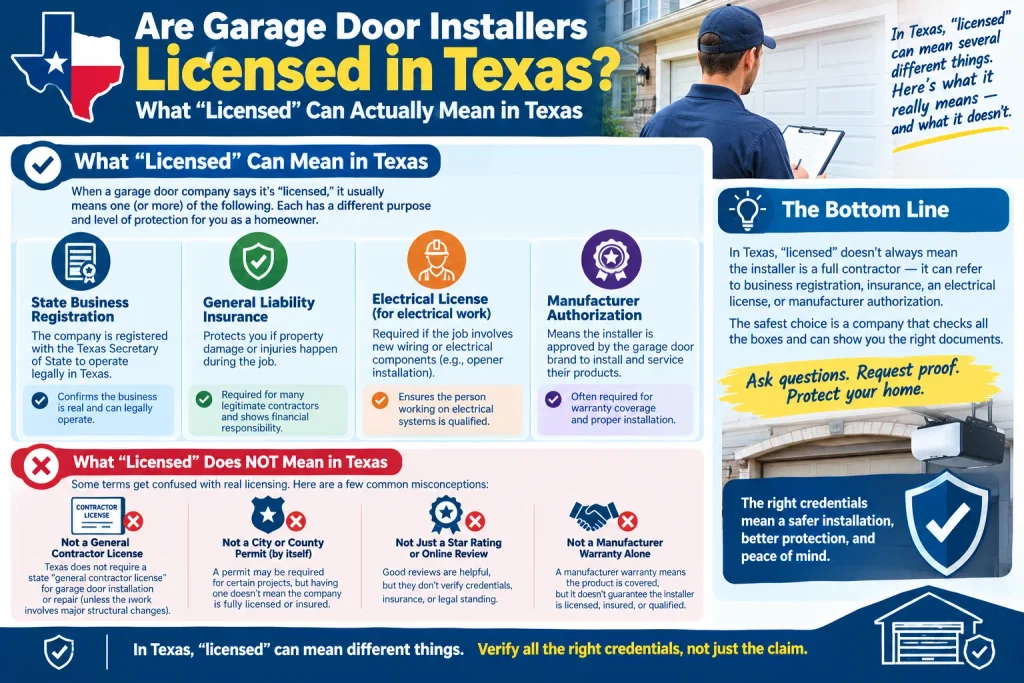
What “Licensed” Can Actually Mean in Texas
| The claim | What it means here | Can you verify it? |
| “Licensed garage door installer” | Nothing specific. No such Texas license exists. | No. Ask which body issued it. |
| “Licensed and insured” | Usually a city business registration plus a liability policy. | Partly. Verify each piece separately. |
| “Registered business” | An active entity in Texas records. | Yes. Texas Comptroller Taxable Entity Search, free. |
| “Licensed electrician on staff” | A real, state-issued license with a number. | Yes. TDLR public license search. |
| “Insured” | A liability policy that may or may not be current. | Yes, but only by calling the insurance agent. |
| “Bonded” | A surety bond, often small and frequently misunderstood. | Yes. Ask for the bond number and issuer. |
| “Certified technician” | An industry credential such as IDEA certification. | Yes. Ask which body and confirm with them. |
| “Authorized dealer” | A manufacturer relationship, not a license. | Yes. Check the manufacturer’s dealer locator. |
The Short Version
The absence of a Texas license is not a reason to worry, it is a reason to ask better questions. Registration, insurance, permits, electrical licensing, industry certification, and a verifiable local footprint together give you more protection than a trade license would, and all six are checkable from your phone while you are still deciding who to call.
At First Call Garage Doors, we put the entity name, the insurance agent’s contact, and the permit answer in front of homeowners before anyone asks, because in a state with no licensing board that is the only thing that separates one truck from another. If you are in Richmond, TX and want a written estimate with those details spelled out, book a free quote or call for same-day service. You can also read more about what a trusted local garage door service looks like, or about the most common garage door repairs so you know what a fair recommendation sounds like before you need one. For ongoing issues with an existing door, start with garage door repair, and for opener faults specifically, garage door opener repair. If your only problem is a handset that stopped working, a garage door remote control visit is usually a short one.
Frequently Asked Questions
2. So does "licensed and insured" mean anything in a Texas garage door ad?
The insured half is meaningful and verifiable. The licensed half is usually a city business registration. When homeowners ask us this, our answer is always the same: ask them to name the licensing body, and see what comes back.
3. Can I check a garage door company's credentials myself?
Yes, and it takes about ten minutes. The Comptroller's entity search is free, TDLR's electrician search is free, and calling an insurance agent costs nothing. Nobody needs to be a contractor to run those three checks.
4. Does my garage door replacement need a permit in Richmond?
That depends on the scope and on current local rules, so confirm it with the city or county building department rather than taking anyone's word for it. The rule of thumb we work from is that anything touching framing, opening size, or new circuits should be assumed to need one until the department says otherwise.
5. Is an uninsured contractor always a bad choice?
Not automatically, but it shifts risk onto you. In Texas, workers' compensation is not required for private employers, so a small legitimate operation may genuinely lack it. General liability is the one we would not proceed without on a door or spring job.
6. Why does garage door work attract so many scams?
Because it combines urgency, no licensing filter, and parts most homeowners cannot price. A door that will not open at seven in the morning is a captive customer. This is one of our most common calls: someone who paid for a spring job that turned into a full opener replacement in the driveway.
7. My door was installed by someone unlicensed years ago. Is it unsafe?
Not necessarily, but it is worth an inspection, particularly the spring sizing, the cable condition, and whether the opener's safety reversal works. Those three things reveal most bad installs, and all three are checkable in a single visit.
8. What should a garage door installation cost in Texas?
It varies widely by door size, material, and insulation, so treat phone quotes as provisional. Expect single-panel repairs at the low end, opener replacements in the middle, and full insulated double doors at the top. Ask for the range in writing before agreeing to anything.
9. How long has the company needed to be in business to be trustworthy?
There is no threshold, but registration dates matter more than advertised claims. A brand new company can be excellent, and plenty of good techs go independent. The concern is a company that markets itself as long-established while its state registration says otherwise.
10. What do I do if I already hired someone unlicensed and the work failed?
Document the invoice, photograph the installation, and get a written second opinion on what was actually done. Then report the business to Google and the Better Business Bureau, and use the industry's consumer reporting channels, which is what makes repeat operators findable to the next homeowner.