
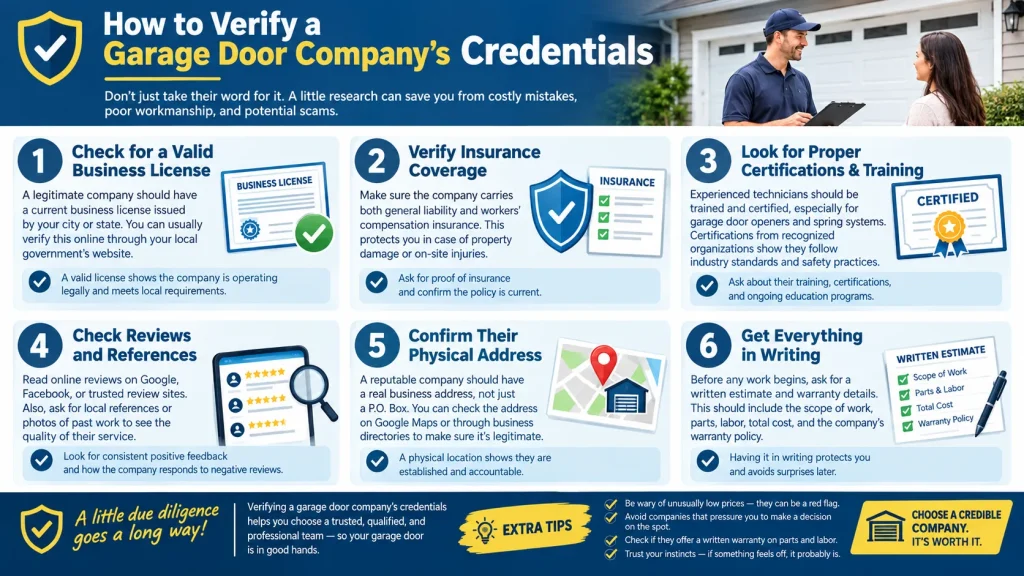
To verify a garage door company’s credentials, ask for their certificate of insurance directly from their insurance agent, confirm the business is registered with the Texas Comptroller, check that the company name matches on the phone, the website, and the truck, and get a written itemized estimate before anyone touches your door. Texas does not issue a state contractor license for garage door work, so a “licensed and insured” claim on a website proves nothing by itself. Every check below takes five minutes or less, and all of them can be done before a technician arrives.
Key Takeaways
- Texas has no state license for garage door installers, so “licensed” in an ad usually refers to a city business registration, not a trade license.
- A certificate of insurance means nothing unless it comes from the insurance agent, not from the contractor.
- Texas does not require private employers to carry workers’ compensation, which makes that one question more important here than in most states.
- The fastest scam filter is a name and address check: search the company’s address on Google Maps before you call.
- Never authorize work without a written, itemized estimate that separates parts, labor, and the service call fee.
- Warranty terms are where legitimate companies and fly-by-night operators differ most, because a warranty is only as good as the company still being in business next year.
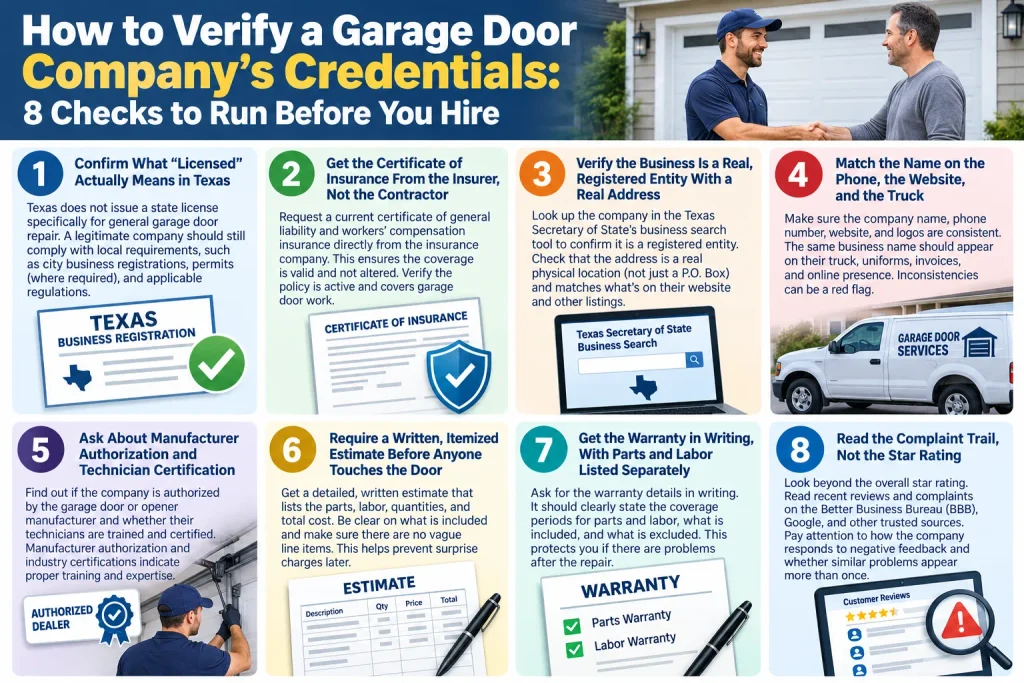
Check 1: Confirm What “Licensed” Actually Means in Texas
Texas does not issue a statewide contractor license for garage door installation or repair. There is no state board to call and no license number to look up, which means a company advertising itself as “licensed” is either referring to a city or county business registration, or the word is doing no work at all.
That does not make the check pointless. It changes what you are checking. Ask which city they are registered in and confirm it with that city’s permitting office. Ask whether the job requires a permit, since replacing a door or adding a new electrical circuit for an opener often does, and pulling a permit puts a municipal inspector between you and a bad install. If the job involves running a new dedicated circuit, that portion is electrical work and requires a licensed electrician under Texas law, so ask who is doing it.
How to verify a garage door contractor’s license in Texas
Call your city or county building department, give them the company name, and ask two questions: is this business registered to work here, and does the work I described require a permit? A company that discourages you from pulling a permit is telling you something. For the full breakdown of what stands in for a state license here, read Are Garage Door Installers Licensed in Texas? 6 Things to Verify Instead.
Call a pro if: the job involves a new opener circuit, a door replacement, or any structural change to the opening. Those are the jobs where permits and inspections exist for a reason.
Check 2: Get the Certificate of Insurance From the Insurer, Not the Contractor
A PDF emailed by the contractor is not verification. Certificates are trivially easy to alter, and an expired policy looks identical to an active one on a scanned document. Ask for the name and phone number of their insurance agent, then call the agent yourself and ask whether the policy is active today.
You are looking for two things. General liability covers damage to your property, which matters because a garage door is a heavy moving assembly mounted to your home’s framing. Workers’ compensation covers injury to the technician. Texas is unusual here: private employers are not required to carry workers’ compensation, so plenty of legitimate small operators do not have it. That is not automatically a red flag, but it does mean you should know the answer before someone is standing on a ladder in your garage.
How to verify garage door company insurance before work starts
Request the agent’s contact information, call to confirm the policy is current, and ask that the certificate list your address as the job site. A company that will not connect you with its agent should not be working on your home. The specific coverage terms worth confirming are covered in Is Your Garage Door Company Actually Insured? 7 Coverage Terms to Confirm.
Call a pro if: you are hiring for spring replacement. Torsion springs store enough energy to cause serious injury, and this is the single job where an uninsured technician is the worst bet you can make. See why professional spring replacement matters for what is actually at stake.
Check 3: Verify the Business Is a Real, Registered Entity With a Real Address
Search the Texas Comptroller’s Taxable Entity Search for the company’s legal name. It is free, public, and takes about a minute. You are confirming the entity exists, is active, and has been registered longer than a few months. Then take the address from their website and search it on Google Maps in satellite and street view.
This is the check that catches the largest category of garage door fraud. The pattern is a national lead-generation operation that spins up a local-looking website with a local phone number and an address that turns out to be a UPS Store, a vacant lot, or a residential house. The call is routed to a call center, then sold to whichever subcontractor is nearest. Clopay recommends exactly this test, advising homeowners to search Google Maps for the showroom address listed on a company’s website to confirm it resolves to a legitimate business location.
How to check if a garage door company is a registered business
Run the legal name through the Comptroller’s entity search, map the physical address, and cross-check the phone number against the address. A company that has served a market for years will have a findable, consistent footprint. If you are comparing several local options, our guide to choosing a garage door repair company walks through what to weigh once the credentials clear.
Call a pro if: you are mid-emergency and tempted to call the first result. That is precisely the moment these operations are built to capture.
Check 4: Match the Name on the Phone, the Website, and the Truck
Call the number and listen to how they answer. A legitimate company answers with its name. Scam operations frequently run dozens of near-identical brand names through one call center, so the person answering will use a generic greeting, hesitate, or give a name that does not match the site you called from.
Clopay’s guidance is blunt on this point: if a company cannot state its own name consistently, choose another one, and if the address they give you on the phone does not match their website and advertising, choose another one. Extend the same test to arrival. The truck should carry the company name, and the technician should be able to produce identification. An unmarked vehicle on a service call is not disqualifying on its own, but paired with a vague phone greeting it is a pattern.
Why a garage door company’s name should match everywhere
One name, one address, one phone number, consistent across the website, the invoice, the truck, and the greeting. Any mismatch is worth a question before work begins, whether the job is a full garage door repair or a ten-minute call to reprogram a garage door remote control.
Call a pro if: the technician who shows up cannot tell you which company he works for. End the visit there.
Check 5: Ask About Manufacturer Authorization and Technician Certification
There is no state license, but there are real credentials, and they come from two places. Manufacturers authorize dealers to sell and service their equipment, which means the company buys direct, gets factory training, and can honor the manufacturer’s warranty. The Institute of Door Dealer Education and Accreditation, the industry body affiliated with the International Door Association, certifies individual technicians and accredits companies.
The distinction matters because “authorized dealer” and “certified technician” are not interchangeable, and neither term is regulated in the way homeowners assume. A company can be an authorized dealer with no certified technicians on staff, and vice versa. Ask which manufacturers authorize them, then verify it on the manufacturer’s own dealer locator rather than taking the badge on their website at face value. This is worth doing carefully for garage door installation, where the manufacturer’s warranty is a large part of what you are paying for.
How to verify a garage door company’s manufacturer certifications
Use the manufacturer’s dealer locator to confirm the company appears, and ask whether the technician assigned to your job holds an individual certification. The differences between these credentials are unpacked in What Does “Authorized Dealer” Mean for a Garage Door Company? 5 Certifications Explained.
Call a pro if: you are having a door installed under warranty. Non-authorized installation can void manufacturer coverage.
Check 6: Require a Written, Itemized Estimate Before Anyone Touches the Door
Get the estimate in writing before work starts, and require that it separate the service call fee, parts, and labor as distinct line items. A single lump sum is not an estimate, it is a number, and it gives you nothing to compare or dispute.
The standard bait-and-switch is a very low advertised service call fee followed by a diagnosis that escalates on arrival: the springs are wrong for the door, the rollers are shot, the opener is unsafe, and the total lands several times higher than the number that got them in the driveway. Clopay’s advice is to get a quote on all recommended services before agreeing to any work, and to get two quotes from different dealers as a safeguard against overcharging. If a technician recommends additional parts, ask why each one is needed and ask to see the failed part.
What a legitimate garage door repair estimate should include
Service call fee, each part named with a quantity, labor separated from parts, the warranty terms, and a total. If the recommendation is a full replacement rather than a repair, get that reasoning in writing too, and check it against whether repair or replacement is actually cheaper in your situation and what a standard tune-up should cost.
Call a pro if: you are being pressured to decide immediately. Legitimate companies will hold a written quote while you get a second one.
Check 7: Get the Warranty in Writing, With Parts and Labor Listed Separately
Ask three questions: how long is the parts warranty, how long is the labor warranty, and who honors each one. Parts warranties usually come from the manufacturer, labor warranties come from the company, and the second is worth far less from an operation that will not exist in eighteen months. This is why business longevity from Check 3 is a warranty question, not just a trust question.
Watch for warranties that are voided by conditions you cannot control, and for verbal assurances that never make it onto the invoice. If it is not written on the paperwork you sign, it does not exist. Ask specifically what happens if the same part fails twice, because that is where thin warranties reveal themselves.
How to verify a garage door repair warranty covers what you think
Read the invoice before signing, confirm the warranty period and what triggers it, and keep the paperwork. For garage door opener repair in particular, confirm whether the warranty covers the logic board and motor separately, since those fail on different timelines.
Call a pro if: a company offers a lifetime warranty with no written terms. Ask what “lifetime” is measured against.
Check 8: Read the Complaint Trail, Not the Star Rating
Star ratings are easy to manufacture. Complaint patterns are not. Read the one and two star reviews specifically, and look for repetition: the same escalation from a cheap service call, the same unnecessary spring replacement, the same unreachable phone number afterward. A handful of bad reviews on a company with years of history is normal. The same complaint appearing fifteen times is a business model.
The industry tracks this actively. The International Door Association maintains a consumer scam awareness resource with a reporting form and a directory of qualified professionals, and its reporting page collects news coverage of scam operations across the country. The association has also used its own channels to raise the alarm, including an International Door Association post on garage door scam activity. If you have already been hit, the IDA’s guidance is to report the business to Google and the Better Business Bureau, and its scam awareness resources include a consumer reporting form. Clopay’s homeowner guide to avoiding garage door scams covers the same ground from the manufacturer’s side.
How to check a garage door company’s reviews and complaint history
Sort reviews by lowest rating, look for repeated complaint patterns rather than isolated bad experiences, and check whether the company responds. Knowing which problems are genuinely urgent also helps you resist pressure tactics, so it is worth knowing which garage door problems are actual safety hazards and which routine maintenance you can handle yourself.
Call a pro if: you suspect you were overcharged for work already done. Get a second opinion in writing before disputing the charge.
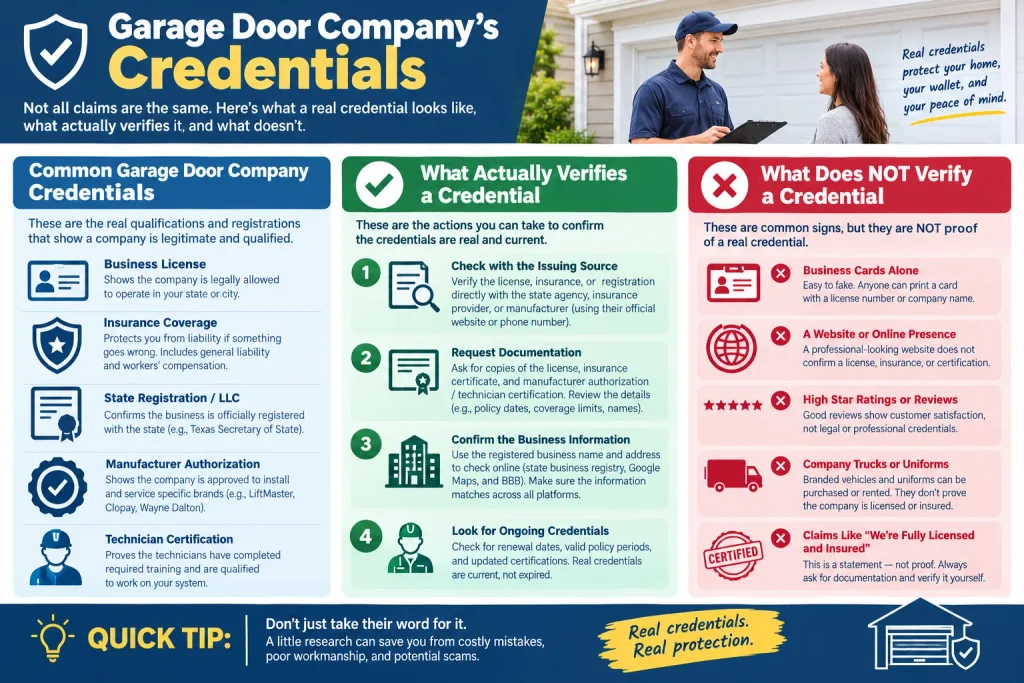
What Actually Verifies a Credential, and What Does Not
| What you will hear | What it proves on its own | How to verify it in five minutes |
| “We’re licensed and insured” | Nothing. Texas issues no garage door contractor license. | Ask which city they are registered in, then call that city’s permitting office. |
| A certificate of insurance PDF | Nothing. Certificates are easy to alter and expired ones look current. | Call the insurance agent listed and ask if the policy is active today. |
| “We’re local” | Nothing. Lead-generation sites buy local phone numbers. | Search their street address on Google Maps satellite and street view. |
| “Authorized dealer” badge on the website | Nothing on its own. Badges are images. | Look the company up on the manufacturer’s own dealer locator. |
| A 4.9 star average | Little. Ratings are easy to inflate. | Read the one and two star reviews and look for repeated patterns. |
| “Lifetime warranty” | Nothing unless written on the invoice with terms. | Ask for the warranty period, parts and labor separately, in writing. |
| A verbal price over the phone | Nothing. This is where bait-and-switch starts. | Require a written itemized estimate before work begins. |
| A business registered for years with a real address | This is a genuine signal. | Texas Comptroller Taxable Entity Search, free and public. |
The Short Version
Every one of these checks is something you can do from your phone in the time it takes a technician to drive over. None of them require you to know anything about garage doors. They only require you to ask for the source of a claim rather than the claim itself: the agent instead of the certificate, the dealer locator instead of the badge, the permitting office instead of the word “licensed.”
At First Call Garage Doors, we hand this information over before we are asked, because a homeowner who has verified who we are is an easier customer to work for. If you are in Richmond, TX and want an itemized written estimate with the insurance and warranty terms spelled out up front, request a free quote or call for same-day service. You can also read more about what to expect from a local garage door company in Richmond, TX, or how to avoid costly repairs before they start.
Frequently Asked Questions
2. How do I know if a garage door company is insured?
Ask for the insurance agent's name and number, then call the agent. This is our rule of thumb from the field: any company that hesitates to connect you with its agent is a company you should keep shopping past. A certificate the contractor emails you is a starting point, not proof.
3. Is a low service call fee a red flag?
Not by itself, but it is the most common opening move in a bait-and-switch. The fee gets a technician into your driveway, and the diagnosis escalates from there. Judge the company on the written estimate that follows, not the number in the ad.
4. Should I get more than one quote for a garage door repair?
For anything beyond a minor adjustment, yes. Two written quotes will tell you quickly whether a recommendation is standard or invented. This is one of the most common calls we get: a homeowner asking us to look at a quote from somewhere else.
5. My garage door stopped working after a power outage. Is that a repair or a reset?
Very often it is a reset. Openers lose their programming or their travel limits after an outage, and remotes sometimes need reprogramming. This is one of our most common calls, and a fair company will tell you on the phone whether it is something you can try yourself first.
6. Why does my remote work up close but not from down the street?
That is usually interference or a weakening antenna, not a failing opener. LED bulbs in the opener are a frequent culprit. A company that immediately quotes you a new opener for a range complaint has skipped the diagnosis.
7. Is it worth repairing an older garage door, or should I replace it?
It depends on the door, not the age. Panels in good condition with worn hardware are usually worth repairing. Rusted or cracked panels, or a door that has come off its tracks more than once, start pushing toward replacement. Anyone who recommends replacement without looking at the panels is guessing.
8. How much should a garage door repair cost?
Costs vary widely by part and by door, so treat any phone quote as provisional. Expect a service call fee in the range typical for home trades in the area, with spring and opener work landing higher than adjustments or roller replacement. Ask for the range in writing before work starts.
9. My garage door only fails sometimes. Is that worth calling about?
Yes. Intermittent faults almost always get worse, and they are cheaper to diagnose before the door fails completely. In our experience, the intermittent problems people ignore for months are the ones that end in an emergency call.
10. What should I do if I think I was scammed by a garage door company?
Document everything: the invoice, the parts you were charged for, and any photos. Get a written second opinion on the work performed. Then report the business to Google, the Better Business Bureau, and the industry's consumer reporting channels, which is what makes these operations findable to the next homeowner.