
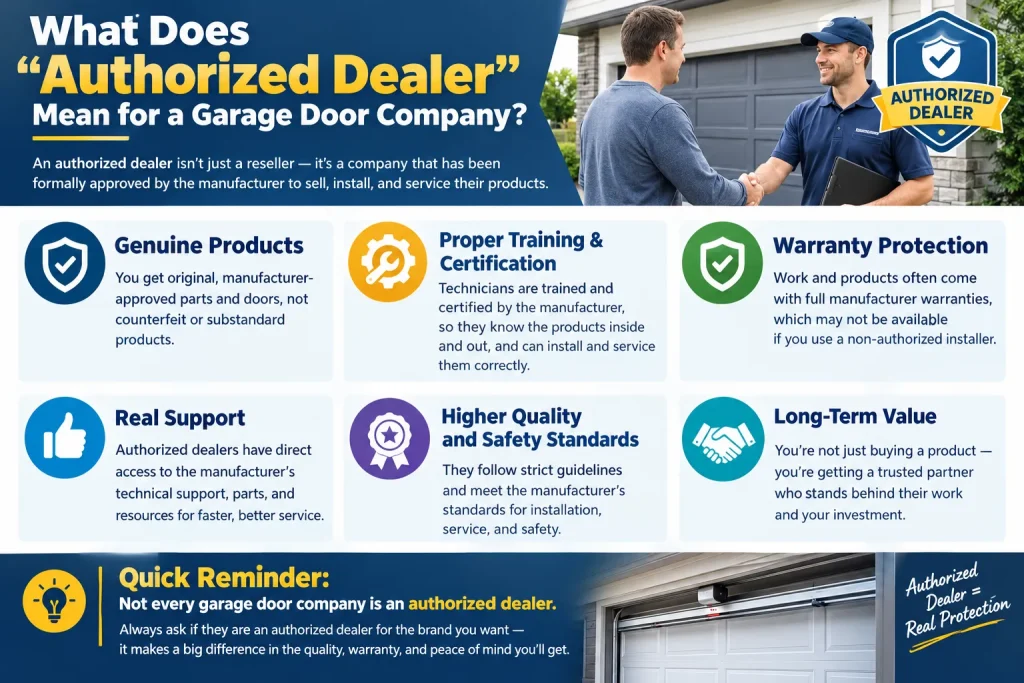
“Authorized dealer” means a manufacturer has approved a company to sell and service its equipment, usually requiring factory training, direct purchasing, and the ability to honor the manufacturer’s warranty. It is a business relationship, not a license and not a technician credential. A company can be an authorized dealer while employing no certified technicians, and an excellent independent technician can hold real certifications while carrying no dealer authorization at all. The five credentials below are the ones that actually exist in this trade, what each one proves, and how to verify it in a few minutes rather than trusting a badge image on a website.
Key Takeaways
- Authorized dealer status is granted by a manufacturer and verifiable on that manufacturer’s own dealer locator, not by the badge on a company’s site.
- Technician certification and company authorization are separate things, and most homeowners assume one implies the other.
- The Institute of Door Dealer Education and Accreditation, affiliated with the International Door Association, is the industry body that certifies individual technicians and accredits companies.
- Directory badges like BBB accreditation and Google screening programs are not trade certifications, though they are not worthless either.
- Non-authorized installation can void a manufacturer’s warranty on a new door or opener, which is the one place this actually costs you money.
- In a state with no garage door license, voluntary credentials carry more weight, because nothing compelled the company to earn them.
Why Any of This Matters in Texas
Texas issues no trade license for garage door installation or repair, which means these voluntary industry credentials are the closest thing to a professional standard that exists here. The full picture of what the state does and does not regulate is in Are Garage Door Installers Licensed in Texas? 6 Things to Verify Instead.
That absence is also why badge clutter works so well as a marketing tactic. A website footer can display eight logos, and most homeowners cannot tell which ones represent training, which represent a purchasing relationship, and which were bought outright. Fraudulent operators lean on exactly this confusion, a pattern the industry documents in the International Door Association’s scam awareness resources.
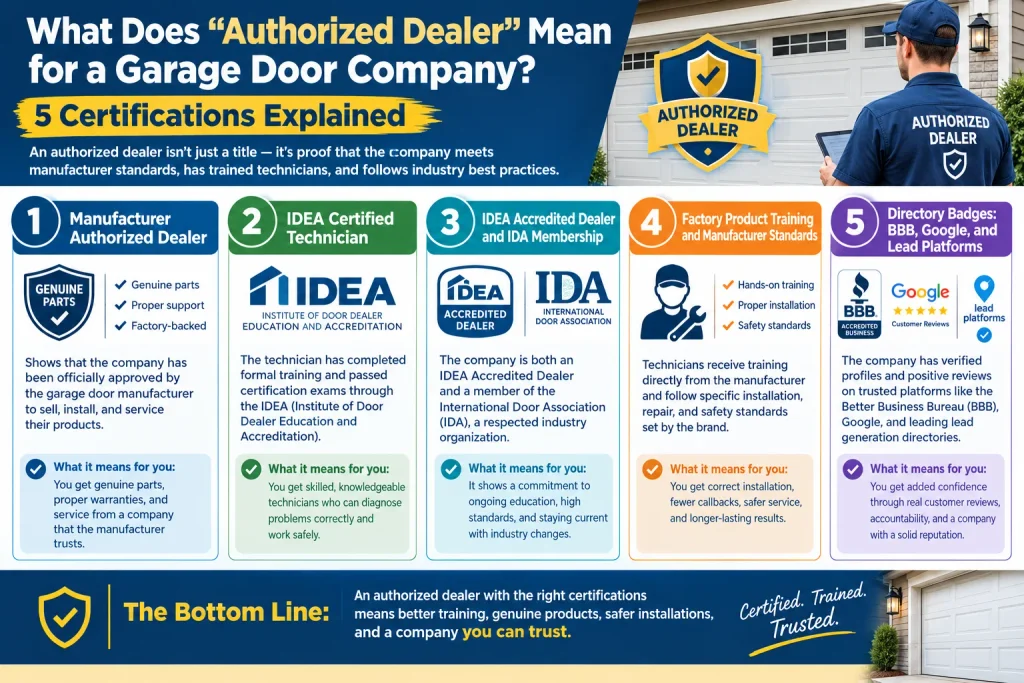
1. Manufacturer Authorized Dealer
This is the credential most companies advertise and the one most often misread. A manufacturer, for example LiftMaster, Chamberlain, Genie, Clopay, or Overhead Door, authorizes a dealer to sell and service its products. Authorization typically requires the company to buy direct rather than through a big box retailer, complete product training, meet volume or service standards, and be able to process warranty claims on the manufacturer’s behalf.
What it proves is real but narrow: this company has an actual relationship with the brand and can honor the factory warranty. What it does not prove is that the technician arriving at your house has been trained, that the company is insured, or that its pricing is fair. Authorization is granted to businesses, not people.
The verification step matters more than the badge. Every major manufacturer runs a public dealer locator on its own site. Search the company name there. A badge image on a contractor’s website costs nothing to add and is not evidence of anything.
How to verify a LiftMaster or Genie authorized dealer
Use the manufacturer’s own dealer locator and search by company name or ZIP code, then confirm the listing matches the legal business name on the estimate. If you are comparing equipment before you choose a company, our guides to LiftMaster garage door openers in Richmond, TX and Genie garage door openers cover what each brand does well.
Verifying the dealer relationship is one step in a longer vetting sequence, laid out in full in How to Verify a Garage Door Company’s Credentials: 8 Checks to Run Before You Hire, which is the master guide this article belongs to.
Call a pro if: you are buying a new opener or door under factory warranty. Non-authorized installation is one of the most common ways that coverage gets voided.
2. IDEA Certified Technician
This is the individual credential, and it is the one worth asking about by name. The Institute of Door Dealer Education and Accreditation, affiliated with the International Door Association, certifies technicians through examination in areas including residential installation and service. It tests the person, not the company.
Certification matters because the trade has no licensing exam, so this is the only standardized measure of whether a technician’s knowledge has been independently assessed rather than absorbed from a coworker. Spring sizing, cable routing, force and travel limit settings, and safety reversal testing are exactly the areas where informal training produces confident, wrong answers.
Ask specifically whether the technician assigned to your job holds certification, not whether the company employs certified technicians generally. Those are different claims, and companies answer the second question when asked the first.
What is an IDEA certified garage door technician
A technician who has passed an industry examination through the Institute of Door Dealer Education and Accreditation. Ask for the certification by name and which technician holds it. This matters most on precision work, including the kind of adjustment covered in how to choose the right garage door opener and on any garage door opener repair involving force settings.
Call a pro if: anyone proposes adjusting spring tension or safety reversal settings without being able to explain how they will test the result. That test is the entire point of the training.
3. IDEA Accredited Dealer and IDA Membership
These two get conflated constantly, and the difference is meaningful. Accreditation through IDEA is a company-level credential requiring the business to meet standards around training, insurance, and business practices. Membership in the International Door Association is exactly what it sounds like: a trade association membership that a company pays to hold.
Both are legitimate signals. Accreditation is the stronger of the two because it involves meeting requirements rather than paying dues. Membership still tells you something, since it means the company is connected to industry training, safety standards updates, and code changes rather than operating in isolation. Neither is a license, and neither replaces the insurance check.
Watch for the wording. “Member of the International Door Association” and “IDEA Accredited Dealer” are different claims, and a company that blurs them in its marketing is telling you how it handles precision generally.
Is IDA membership the same as accreditation
No. Membership is paid, accreditation is earned by meeting standards. Ask which one the company holds, and treat vagueness as an answer. Whichever it is, pair it with the coverage verification in Is Your Garage Door Company Actually Insured? 7 Coverage Terms to Confirm, because credentials and coverage protect you against completely different failures.
Call a pro if: you are hiring for a full replacement. Accredited companies are more likely to follow current standards on headroom, backroom, and spring sizing for garage door installation.
4. Factory Product Training and Manufacturer Standards
Beyond dealer authorization, manufacturers run product-specific installer training, and technicians who complete it are trained on that equipment specifically rather than on garage doors generally. This is a narrower credential and a genuinely useful one, because openers have diverged substantially. Programming logic, safety sensor wiring, smart connectivity, and force calibration differ enough between brands that experience with one does not fully transfer to another.
Separately, the Door and Access Systems Manufacturers Association publishes the technical standards the industry builds to, covering things like wind load and spring cycle ratings. DASMA is a standards body for manufacturers, not a dealer credential, so a company cannot be “DASMA certified.” If you see that claim, the company is either careless or hoping you will not check.
Do garage door technicians need brand-specific training
Not formally, but it shows in the work, particularly on programming and sensor faults. Brand differences are why a garage door remote control that pairs one way on a Chamberlain unit behaves differently on another system, and our guide to Chamberlain garage door openers in Richmond, TX covers where those differences show up.
Call a pro if: a technician cannot explain how your specific opener’s safety reversal is tested. That procedure is brand-specific and it is the single most important safety feature on the unit.
5. Directory Badges: BBB, Google, and Lead Platforms
These appear alongside real certifications and are not the same category. BBB accreditation is a paid membership requiring adherence to the bureau’s standards and complaint resolution process. Google’s screening programs verify license and insurance where applicable and run background checks, and some offer a limited guarantee on jobs booked through them. Lead platforms like the major home services marketplaces run their own screening of varying rigor.
None of these evaluate technical competence. What they do provide is a complaint trail and, in some cases, a screening floor. That is worth something, especially the complaint history, which is often more revealing than any badge. Just do not read a BBB rating as evidence that someone knows how to size a torsion spring.
The reason to understand this distinction is that badge-heavy websites are a documented pattern among operations that have no real credentials to display, which is covered from the manufacturer’s side in Clopay’s homeowner guide to avoiding garage door scams.
Does BBB accreditation mean a garage door company is qualified
No. It reflects membership and complaint handling, not technical training. Use it for complaint history, then verify the actual credentials separately. The same logic applies when you are evaluating quotes for garage door repair, where badge count and competence correlate poorly.
Call a pro if: a company’s credibility rests entirely on directory badges with no manufacturer authorization or technician certification behind them. The industry has been flagging that exact profile publicly, including in an International Door Association post on garage door scam activity.
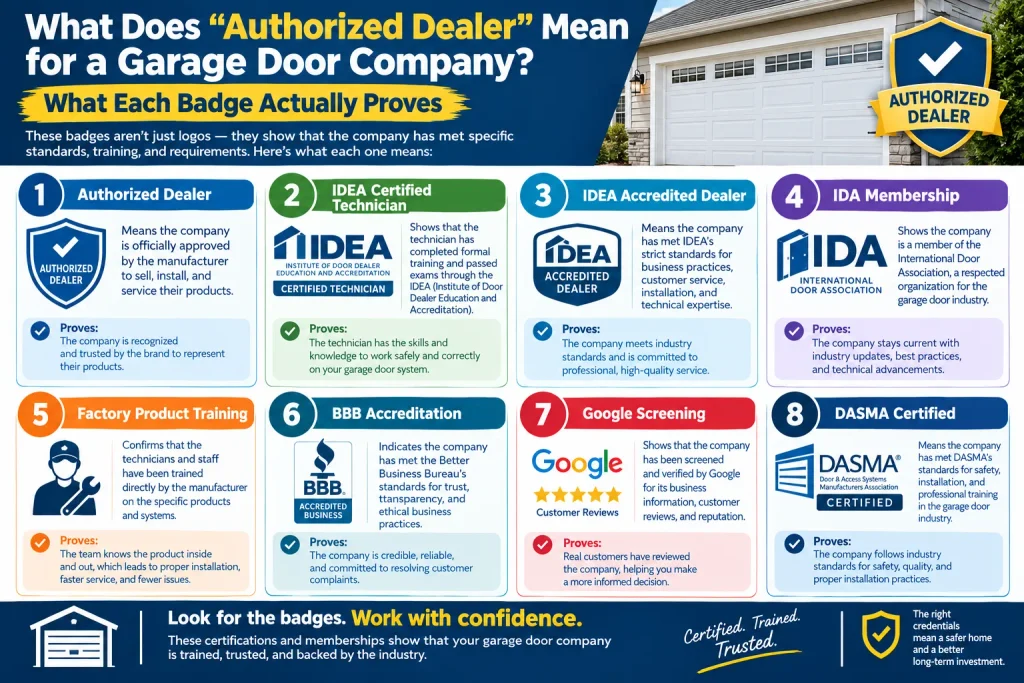
What Each Badge Actually Proves
| Credential | Who issues it | What it proves | How to verify |
| Authorized dealer | The manufacturer | A real purchasing and warranty relationship with that brand | The manufacturer’s own dealer locator |
| IDEA certified technician | Institute of Door Dealer Education and Accreditation | An individual passed an industry examination | Ask which technician holds it, confirm with the issuing body |
| IDEA accredited dealer | Institute of Door Dealer Education and Accreditation | The company met standards on training, insurance, and practices | Ask for accreditation status by name |
| IDA membership | International Door Association | Paid trade association membership and industry connection | Ask directly, membership is not accreditation |
| Factory product training | The manufacturer | Technicians trained on that specific equipment | Ask which brands and which technicians |
| BBB accreditation | Better Business Bureau | Paid membership plus a complaint resolution record | The BBB listing, useful mainly for complaint history |
| Google screening | Background and, where applicable, license and insurance screening | The provider profile in Google’s program | |
| “DASMA certified” | Nobody. This is not a real credential. | Nothing. DASMA sets manufacturer standards. | Treat the claim itself as a warning sign |
The Short Version
The one question that separates a real credential from a logo is simple: who issued it, and can I confirm that with them directly. Manufacturer authorization confirms on the manufacturer’s site. Technician certification confirms with the certifying body. Directory badges confirm on the directory, and tell you about complaints rather than competence. Anything that cannot be traced back to an issuer is decoration.
At First Call Garage Doors, we name the manufacturers we are authorized by and the technician assigned to your job, because in a trade with no licensing exam that is the difference between a credential and a graphic. If you are in Richmond, TX and want an estimate that lists the equipment brand, the warranty terms, and who is doing the work, get a free quote or call for same-day service. It is also worth reading what to expect during a garage door replacement and which factors matter most when choosing a replacement door before you compare bids.
Frequently Asked Questions
2. Can a non-authorized company still install my new opener properly?
Technically yes, and many do excellent work. The risk is the warranty. Several manufacturers limit or void coverage on units installed by non-authorized parties, so ask the manufacturer directly before assuming the warranty survives.
3. My technician is not certified but has 20 years of experience. Is that a problem?
Not necessarily. Certification measures tested knowledge, experience measures accumulated judgment, and the best technicians usually have both. What we would want to hear from an uncertified veteran is a clear explanation of how they size springs and test safety reversal. Those two answers reveal more than any credential.
4. How do I check if a company is really an authorized dealer?
Go to the manufacturer's website and use its dealer locator, then match the result against the legal business name on your estimate. This is one of our most common suggestions to homeowners, and it takes about a minute.
5. What is the difference between a certified technician and a certified company?
The first is a person who passed an exam. The second is a business that met company-level standards. Ask which one the badge on the website refers to, because they are frequently displayed interchangeably.
6. Does an authorized dealer have to use genuine parts?
They are expected to for warranty work, which is much of the point. Aftermarket springs, rollers, and logic boards are common in this trade and are not automatically bad, but on a warranty repair a substituted part can create a coverage argument later. Ask what is being installed and whether it is OEM.
7. If a company has no certifications at all, should I walk away?
Not automatically, but then insurance, business registration, and complaint history have to carry the whole weight of your decision. Our rule of thumb from the field is that the fewer verifiable credentials there are, the more important the written estimate and the coverage check become.
8. What should certified installation cost compared to a general handyman?
Expect a moderate premium over general handyman rates, reflecting training, genuine parts, and warranty support. Ask for the range in writing and compare what is included rather than comparing headline numbers, because the cheaper bid frequently excludes hardware the job actually needs.
9. Do certifications expire?
Industry certifications generally require renewal and continuing education, and manufacturer authorizations are reviewed periodically. Ask when the credential was last renewed, particularly if a company is citing something earned many years ago.
10. Which credential matters most if I can only check one?
Insurance, every time. Certification tells you the work is more likely to be done correctly. Insurance determines what happens if it is not, and only one of those two protects your property on the day something goes wrong.