
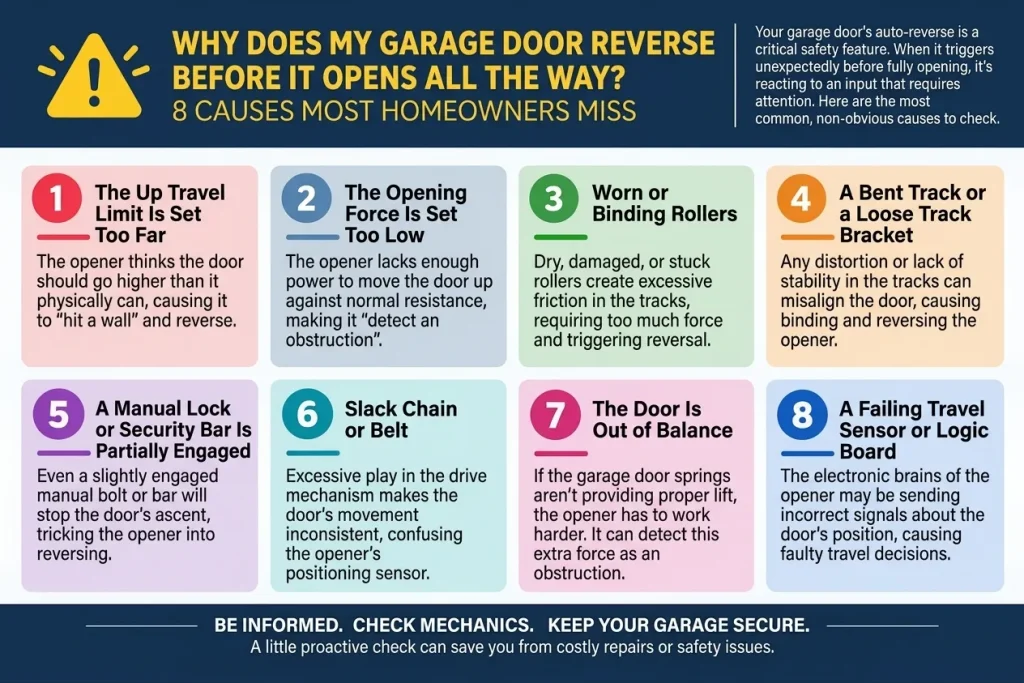
If your garage door starts up and then goes back down, stop checking the sensors. Photo eye sensors only govern the closing cycle. They exist to stop a door from closing on a person or a car, and they have no role whatsoever in opening. A door that reverses while opening is doing something different: the opener has sensed resistance it was not expecting, or it has run into a hard stop, and it has backed off deliberately. That reversal is a safety system working correctly on a problem somewhere else. The two most common places to find that problem are the opener’s travel and force settings, and a physical binding point in the door hardware. Both are worth checking before you spend money on a new opener.
Key Takeaways
- Photo eyes do not stop a door from opening. Cleaning or realigning them will not fix this.
- Reversal on the way up means the opener sensed resistance or hit a limit. It is a response, not a fault.
- Where in the travel it reverses is the single most useful clue. Note it before you call anyone.
- Never raise the opening force repeatedly to push through a reversal. That defeats the protection the reversal provides.
- Intermittent reversal is not less serious than consistent reversal. It usually means earlier.
- Do not attempt to disable or bypass the reversal behavior. On residential openers it is federally required.
If your door stops short without reversing at all, or stops in the first few inches, the diagnosis changes. Start with the master guide: Why Is My Garage Door Not Opening All the Way? 10 Common Causes and How to Fix Them.
First, the Sensor Myth
Nearly every homeowner who calls us about this has already cleaned the photo eyes, and a fair number have realigned them. It is a reasonable guess and it is the wrong system.
Photo eyes sit four to six inches off the floor on either side of the opening. The beam between them is monitored during closing only. Break it while the door is coming down and the door reverses, which is exactly what it is for. Break it while the door is going up and nothing happens, because the opener is not watching it.
What does watch the opening cycle is the opener’s inherent entrapment protection: a force and travel monitoring system inside the motor unit. When the door meets more resistance than the opener expects, or when the trolley reaches something it cannot pass, that system reverses the door. Industry guidance on both protection systems, and on why the six inch mounting height matters, comes from the Door and Access Systems Manufacturers Association.
So if your sensors genuinely are the problem, the symptom you would see is a door that will not close, not one that will not open. That is a different article, and ours is why won’t my garage door close. If you need the alignment procedure for a closing problem, how to align garage door sensors covers it.
With that cleared up, here are the eight causes that actually produce a reversal on the way up.
1. The Up Travel Limit Is Set Too Far
Symptom: The door opens fully, or nearly fully, then bounces and comes back down. You may hear a distinct thump at the top just before it reverses.
Most likely cause: The up travel limit has been set past the point where the trolley meets the stop bolt at the end of the rail. The trolley hits a solid object, the opener reads that impact as an obstruction, and it does what it is designed to do.
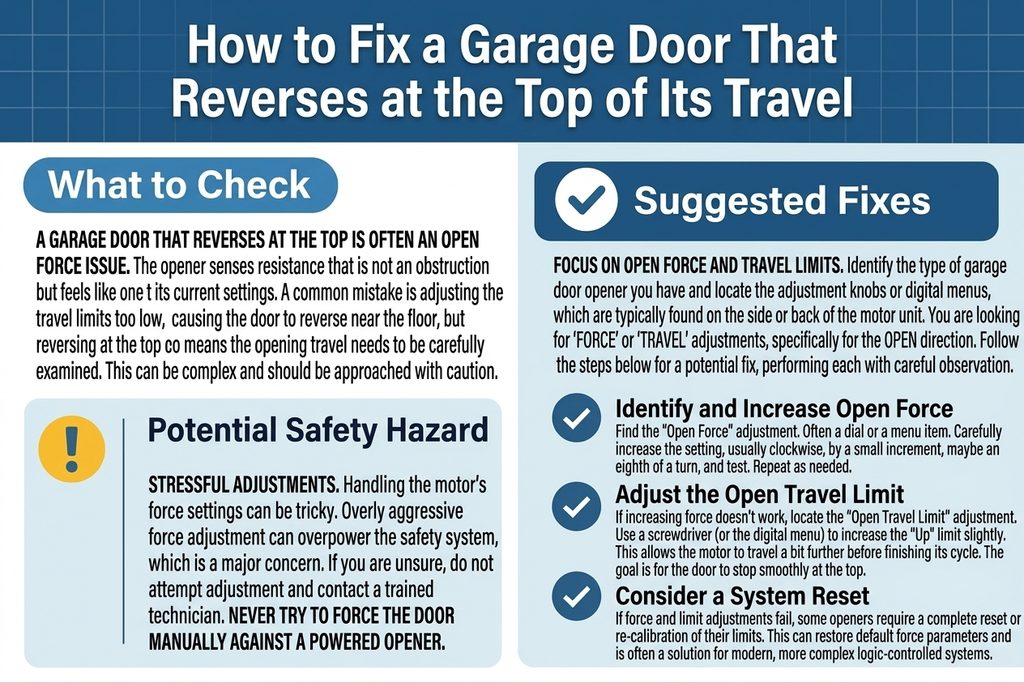
Fix steps:
- Watch the top of the travel. If the reversal follows an audible thump, this is almost certainly it.
- Locate the up travel adjustment on the motor head.
- Reduce the up travel in small increments until the door stops cleanly short of the hard stop.
- Confirm the door still clears your tallest vehicle after the reduction.
This is the single most common outcome of a well-intentioned homeowner adjustment, and it usually appears within a day of someone trying to make the door open further. Rail and stop bolt details vary by model, and garage door rails covers the components involved.
Call a pro if: reducing the travel does not stop the reversal, or the trolley shows damage from repeated impacts.
How to Fix a Garage Door That Reverses at the Top of Its Travel
Because the reversal happens at full height, people assume the door is fine and the opener is faulty. It is the opposite. The opener is correctly refusing to keep driving into an immovable object. For the full set of limit and force adjustments behind this behavior, see Why Does My Garage Door Stop Halfway When Opening? 6 Travel Limit and Force Settings to Check First.
2. The Opening Force Is Set Too Low
Symptom: The door climbs, visibly slows, then backs down. The reversal point moves around from day to day, and it tends to be worse on hot afternoons.
Most likely cause: Force settings cap how hard the opener may pull. Set marginally low, normal friction crosses the threshold and the opener treats it as an obstruction. A setting that was adequate in mild weather can fail once summer friction is added.
Fix steps:
- Run the manual lift test first. Close the door, pull the emergency release, and lift by hand. If the door is heavy or drops, stop here.
- If the door lifts easily, increase the up force by one small increment.
- Test, and increase again only if necessary.
- Retest the safety reversal afterward with a 2×4 laid flat in the door’s path during closing.
Call a pro if: the force has to go up more than once for the same symptom. That is compensation, not correction, and our piece on when a garage door opener needs repair rather than adjustment covers where that line sits. On commercial units the underlying issue is more often an undersized door operator system than a force setting.
Why Low Opener Force Makes a Garage Door Reverse Partway Up
The tell that separates this from a travel limit problem is where it happens. A travel limit reversal occurs at the top, after a thump. A force reversal occurs mid-travel, after a slowdown, at a height that varies.
3. Worn or Binding Rollers
Symptom: The door climbs in a stuttering way, often grinding or squealing, and reverses at roughly the same point each time. That point is frequently the curve where the vertical track turns horizontal.
Most likely cause: Rollers with failed bearings stop rolling and start dragging. Resistance builds as the door climbs, spikes at the curve where the load changes direction, and the opener reverses.
Fix steps:
- With the door closed, inspect each roller for flat spots, wobble, missing bearings, and rust.
- Check that no roller has worked partway out of the track.
- Replace worn rollers as a complete set so the door tracks evenly.
Our walkthrough is in how to replace garage door rollers.
Call a pro if: the bottom rollers are involved. Bottom brackets are attached to the lift cables and carry spring tension, and removing one is a common cause of serious injury.
Why Binding Rollers Cause a Garage Door to Reverse at the Same Point
The consistency of the reversal point is diagnostic. A physical binding point produces a reversal at the same height every time, because the obstruction is at a fixed location in the track. Settings problems do not behave that way.
4. A Bent Track or a Loose Track Bracket
Symptom: The door reverses at one specific height. You may see a scrape mark, a dent, or a bracket pulling away from the wall at that point.
Most likely cause: A dent, a seam gap, or a bracket that has loosened creates a pinch point. The door reaches it, resistance spikes, and the opener backs off.
Fix steps:
- Close the door and sight down both tracks from the floor.
- Look for dents, separation at seams, and brackets standing proud of the wall.
- Clear anything stored against the tracks.
- Snug an obviously loose bracket bolt, but stop there.
Track support hardware matters more than people realize, and door track and backhang support explains how the geometry is held. If the door is also visibly out of square, what to do if your garage door is crooked is the better starting point.
Call a pro if: the track is bent, separated, or misaligned. Straightening fatigued steel by hand usually worsens the geometry. Track alignment is also one of the things a correct garage door installation sets up properly from the start, which is why this failure shows up disproportionately on doors that were installed in a hurry.
Why a Bent Garage Door Track Makes the Door Reverse While Opening
Track faults are the version of this problem most likely to escalate. A door fighting a pinch point puts load into rollers, hinges, and brackets simultaneously, and what begins as a reversal can end with the door leaving the track entirely.
5. A Manual Lock or Security Bar Is Partially Engaged
Symptom: The door lifts an inch or two, hits something solid, and reverses immediately. Often follows a vacation, a power outage, or a house guest.
Most likely cause: Many doors still have a slide lock or a security bar on the inside. Partially engaged, it catches the track and stops the door hard. This is the cause homeowners miss most often, because the lock looks closed enough to be ignored.
Fix steps:
- Look at both sides of the door at waist height for a slide bolt or lock bar.
- Confirm it is fully retracted, not partly.
- If your opener has a lock feature on the wall console, confirm that is off as well.
Worth knowing regardless: how to open your garage door from the outside manually covers what to do when you are locked out on the wrong side of this.
Call a pro if: the lock bar is bent from being driven against, or the track is damaged where it caught.
Why a Partially Engaged Lock Makes a Garage Door Reverse Immediately
The signature here is how early it happens. A reversal within the first few inches, with a hard mechanical stop rather than a slowdown, points at a lock or an obstruction rather than at settings. If the door instead lifts a few inches and simply stops without reversing, the likely cause moves into the counterbalance, covered in Why Does My Garage Door Only Open a Few Inches Before Stopping? 7 Spring and Cable Problems Behind It.
6. Slack Chain or Belt
Symptom: The door reverses unpredictably. You hear the chain slapping the rail, or see it sagging well below the rail when the door is closed.
Most likely cause: Slack introduces a jerk at the start of travel and at direction changes. The opener reads that sudden load spike as an obstruction. Chains stretch gradually, so this arrives slowly enough that people adapt to it without noticing.
Fix steps:
- With the door closed, compare the chain or belt position against the rail.
- Tension to your model’s specification using the turnbuckle or adjustment nut.
- Do not overtighten, since excess tension wears the sprocket and motor bearings faster than slack does.
- Re-learn the travel limits afterward, because the reference point has shifted.
Left alone, this is a good example of how minor garage door problems become failures.
Call a pro if: the chain has stretched beyond the adjustment range, or the sprocket teeth are visibly worn.
Why a Loose Chain Causes Intermittent Reversal While Opening
Slack-related reversals are intermittent by nature, because the jerk depends on how the chain happens to be sitting at the moment the motor starts. Intermittent symptoms get dismissed as gremlins. This one has a specific, fixable cause.
7. The Door Is Out of Balance
Symptom: The door is heavy by hand, does not hold position when lifted manually, and reverses partway up under power. The reversal point creeps lower over weeks.
Most likely cause: Springs carry the door’s weight. As they fatigue, the opener meets more load than it is rated for and reverses. This is the cause where continuing to adjust settings is actively harmful.
Fix steps: None that are safe. Stop operating the door and book service.
Call a pro if: the manual lift test fails, which is to say the door is heavy, drags, or drops. Spring systems store enough energy to cause serious injury and are not a homeowner repair. The same fatigue produces the failure described in what causes a garage door to slam shut. Where a door has aged out across the board, a full garage door replacement re-sizes the springs to the actual door rather than inheriting whatever was fitted before.
Why an Unbalanced Garage Door Reverses Before Reaching the Top
This is the cause behind most of the reversals we are called out for that turn into larger jobs. The reversal is the last warning before a spring failure, and it is the cheapest possible moment to intervene.
8. A Failing Travel Sensor or Logic Board
Symptom: The door reverses at random heights with no audible resistance, no grinding, and no pattern. Settings adjustments produce no lasting improvement. Lights may flash a diagnostic code.
Most likely cause: Openers monitor motor rotation to infer door position and load. When that sensing hardware or the logic board begins to fail, the opener receives a false obstruction signal and reverses a door that is moving perfectly well.
Fix steps:
- Note any flashing light or beep pattern during the reversal. These are diagnostic codes.
- Cross reference against your manual before changing settings.
- Confirm the opener is on a properly grounded, dedicated outlet.
Call a pro if: the reversal is random, the codes point to the logic board, or the unit is past twelve to fifteen years. At that age a replacement garage door opener generally costs less than a board plus labor and brings a current warranty.
Why a Faulty Logic Board Makes a Garage Door Reverse for No Reason
Worth being clear about what is happening here. A false obstruction signal is still the safety system doing its job on bad information. The reversal behavior itself is not optional equipment: entrapment protection for residential openers is mandated by federal rule, published and maintained through the Federal Register, where the safety standard for automatic residential garage door operators is issued. That is the reason no reputable technician will disable it, and the reason an opener that reverses falsely gets repaired or replaced rather than bypassed.
Where It Reverses Tells You What Failed
| Reversal point | What you hear | Most likely cause | Safe to address yourself? |
| At or near full height | A thump, then reversal | Up travel limit set past the rail stop | Yes, reduce travel in small increments |
| Mid-travel, varying height | Motor slows first | Opening force set too low | Yes, once, after the manual lift test |
| Same height every time, at the track curve | Grinding or squealing | Worn or binding rollers | Top and center rollers only |
| Same height every time, flat section | Scrape or scrape mark visible | Bent track or loose bracket | Inspection only |
| Within the first few inches, hard stop | A solid clunk | Slide lock or security bar engaged | Yes, retract the lock fully |
| Random, with chain noise | Chain slapping the rail | Slack chain or belt | Yes, tension to spec |
| Mid-travel, door heavy by hand | Motor straining | Spring fatigue, door out of balance | No |
| Random, no noise, no pattern | Nothing unusual | Travel sensor or logic board fault | No |
Most of the rows above are a fifteen minute fix or a same-day service call. The ones that are not tend to be the ones people leave longest, which is covered in garage problems that are a safety hazard and need fixing right away. Whatever the cause turns out to be, retest the safety reversal once the repair is done, because a working reversal system is the thing standing between a 200 pound door and whatever is underneath it. More on that in garage door safety and protecting your family and property.
Do Not Fight the Reversal, Find Out What Triggered It
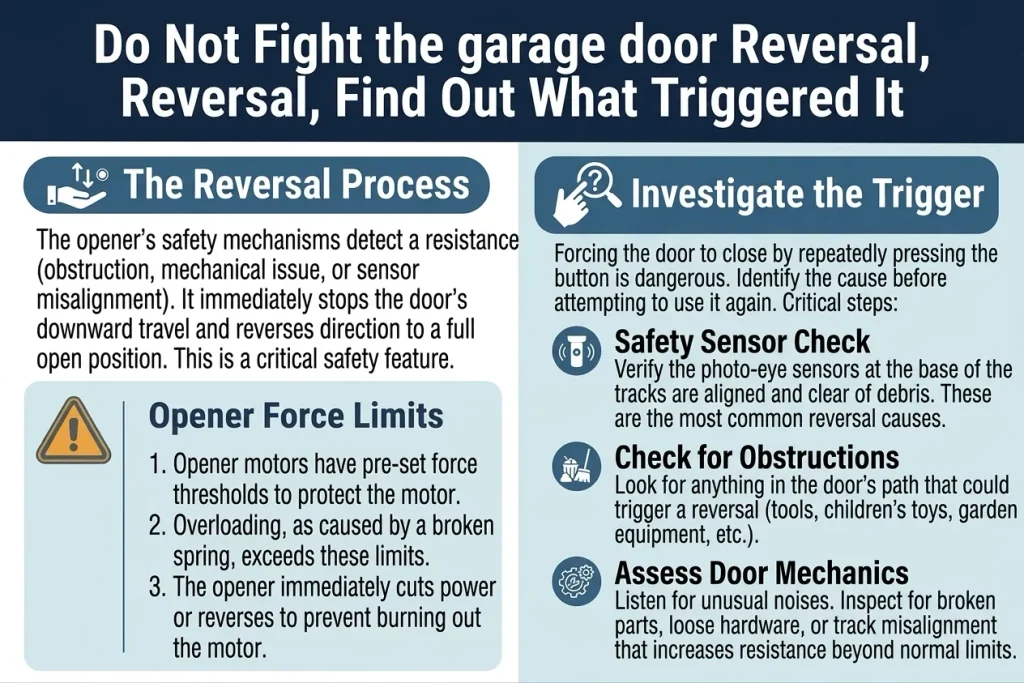
The instinct when a door keeps reversing is to make it stop reversing, usually by raising the force until the opener pushes through whatever it found. That works, briefly, and it removes the one system designed to stop the door when something is in the way. The better move is to treat the reversal as information. Note where it happens, note what you hear, and the eight causes above narrow to one or two quickly.
If your door is reversing on the way up anywhere in Richmond, Katy, Sugar Land, Fulshear, Rosenberg, Missouri City, or the surrounding Fort Bend County area, First Call Garage Doors can identify the trigger in a single visit, tell you honestly whether it is a settings correction or a hardware repair, and in most cases fix it the same day.
Book your same-day garage door diagnostic or request a free quote.
Frequently Asked Questions
2. It opens fully some days and reverses on others. Why is it intermittent?
Intermittent usually means marginal. A force setting that is only just adequate will fail on a hot afternoon and pass on a cool morning. A slack chain produces a jerk only when it happens to be sitting a certain way at startup. In our experience intermittent reversal is not a less serious version of the problem, it is an earlier one, which makes it the better time to look at it.
3. Is it safe to keep using the door while I sort this out?
For a lock bar or a travel limit set too far, the risk is mostly to the opener. For anything where the door feels heavy by hand, no, and we would ask you to stop. A door that reverses because the springs are fatiguing is giving you its last warning, and the failure that follows is the one that damages property and hurts people.
4. The opener lights flash a set number of times when it reverses. Does that mean something?
Yes, and it is the most useful thing you can tell us on the phone. Flash and beep counts are diagnostic codes, not general distress signals. Count them, check them against your manual, and if you call us, lead with the count. It often narrows the visit before we arrive.
5. This started right after I adjusted the travel limits. Did I break something?
Almost certainly not. You most likely increased the up travel past the point where the trolley meets the stop bolt, so the opener now runs into a hard stop and reverses. Back the up travel off a little and it should resolve. This is one of our most common follow-up calls after a homeowner adjustment, and it is usually a two minute correction.
6. Does a door that reverses mean I need a new opener?
Usually not. Most of what we find on this call is settings, a lock bar, rollers, chain tension, or a track issue, none of which require a new unit. The exception is an opener with a failing board or travel sensor, which on an older unit is generally where replacement starts making more financial sense than repair. We will tell you which side of that line you are on before quoting anything.
7. Why is this worse in the summer?
Heat and humidity both add friction. Components expand, lubricant thins, and any setting that was borderline crosses its threshold. Our rule of thumb from the field is that summer does not usually create the problem, it exposes a system that was already running close to its margin.
8. Can you just turn off the reversing feature so the door stays open?
No, and we would not do it even if a customer insisted. Entrapment protection on residential openers is a federal requirement, not a manufacturer preference, and it is the system that stops the door from closing on a child. If your door reverses falsely, the correct answer is to find the trigger or replace the failing hardware, never to disable the protection.
9. What does this usually cost to fix?
It depends entirely on which of the eight it turns out to be. A lock bar, a travel adjustment, or a chain tension correction lands at the low end, roughly a standard diagnostic visit. Rollers and track work sit in the middle. Spring work and opener replacement are the higher end. We quote before we start and we do not begin work you have not approved. Call for current pricing, since parts costs move.
10. How do I check that my safety reversal is actually working?
Lay a 2x4 flat on the floor in the door's path and close the door. When the door contacts the board it should reverse and return to open. If it stops without reversing, or keeps pressing down, stop using the opener and have it serviced. Run this test after any force adjustment and, as a habit, once a month. It takes under a minute and it is the most valuable minute of garage door maintenance there is.