
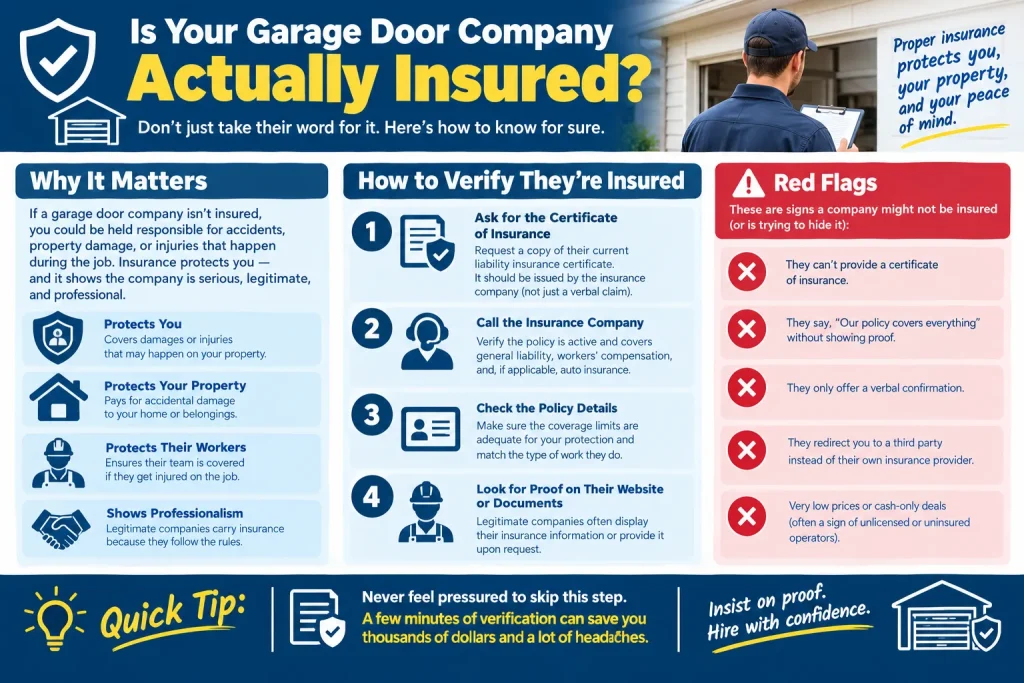
To confirm a garage door company is actually insured, ask for the insurance agent’s name and phone number, call the agent directly, and verify that a general liability policy is active today. A certificate emailed by the contractor is not proof, because certificates are easy to alter and an expired policy looks identical to a current one on a scan. In Texas, where no state license exists for garage door work, insurance is the main financial protection a homeowner has. The seven terms below are what to confirm, and all of them can be settled in one phone call before anyone touches your door.
Key Takeaways
- The only reliable verification is a call to the insurance agent. Everything the contractor hands you is a claim, not evidence.
- General liability is the coverage that pays if your car, wall, or door frame is damaged. Confirm the per-occurrence limit, not just that a policy exists.
- Texas does not require private employers to carry workers’ compensation, so ask about it directly rather than assuming.
- “Bonded” and “insured” are different things, and a surety bond is usually much smaller than homeowners expect.
- Completed operations coverage is the term almost nobody asks about, and it is the one that matters when a bad install fails months later.
- Ask to be named as certificate holder so you are notified if the policy is cancelled mid-project.
Why Insurance Carries More Weight in Texas
In most trades, a state license is the first filter and insurance is the backup. Garage door work in Texas has no first filter, because the state issues no trade license for it. That makes insurance the primary thing standing between a bad afternoon and a bill you pay yourself. The full picture of what does and does not exist here is covered in Are Garage Door Installers Licensed in Texas? 6 Things to Verify Instead.
The risk is not theoretical. A residential door assembly weighs a few hundred pounds, runs on cables under tension, and is anchored to structural framing a few feet above where you park. When something goes wrong during a repair, the damage lands on the car, the drywall, the opener, or the person underneath it. Fraudulent operators know this, which is part of why the trade draws the scam activity documented in the International Door Association’s consumer scam awareness resources.
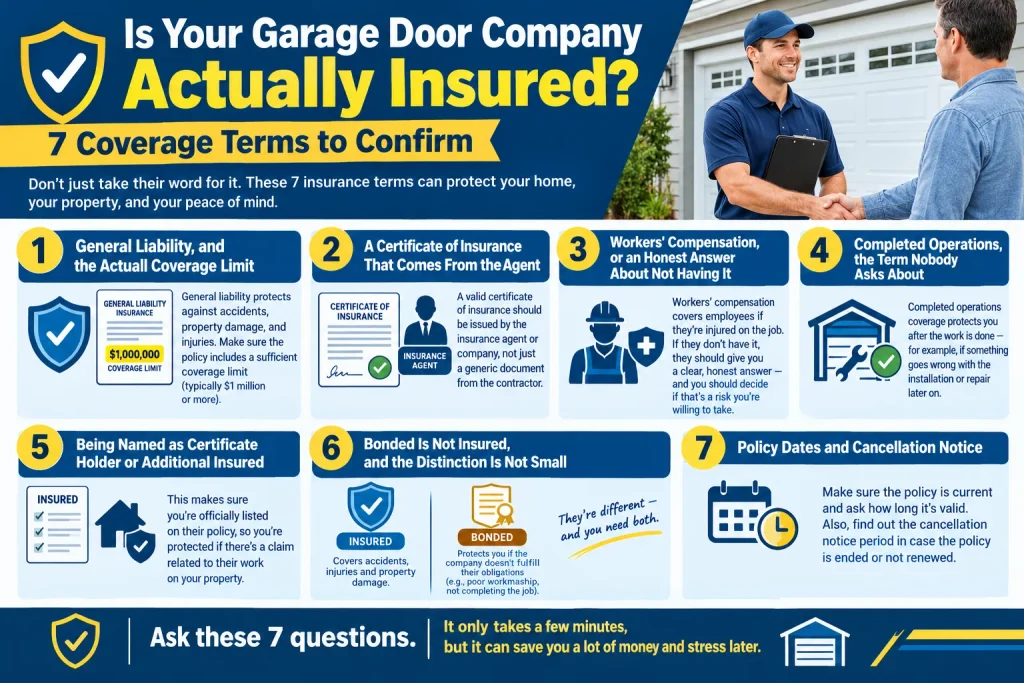
1. General Liability, and the Actual Coverage Limit
General liability is the policy that pays when the contractor damages your property. Do not stop at confirming one exists. Ask for the per-occurrence limit and the aggregate limit, because they are different numbers and only one of them applies to your job.
Per occurrence is the maximum for a single incident, which is the figure that matters to you. Aggregate is the total the policy will pay across the whole policy year, and it can already be partly consumed by earlier claims you will never hear about. For typical residential work, a per-occurrence limit in the low seven figures is standard in this trade. Anything materially below that on a job involving a full door replacement is worth a second look.
How much liability insurance should a garage door contractor carry
Ask for both limits by number, and match them against the value of what is in your garage. If your vehicle is parked under the door during the work, that vehicle is inside the risk. For a full garage door installation, the exposure includes framing and the opening itself, not just the door panels.
Call a pro if: the company cannot state its own coverage limit. A legitimate contractor knows this number, because their commercial customers ask for it constantly.
2. A Certificate of Insurance That Comes From the Agent
The certificate of insurance, or COI, is the standard one-page document summarizing a policy. Contractors hand these out routinely, and that is exactly the problem: the version you receive from the contractor proves nothing. A PDF can be edited in a minute, and a certificate from a policy that lapsed in March looks identical to one that is current.
Ask for the insurance agent’s name and direct phone number, then call. Ask one question: is this policy active today. It takes under two minutes and agents field this call constantly, so it is not an imposition or an insult. What tells you something is the reaction from the contractor. A company that hesitates to connect you with its agent has given you your answer.
How to verify a contractor’s certificate of insurance
Request the agent’s contact details rather than the certificate itself, confirm the policy is in force, and ask the agent to send the COI directly if you want a copy for your records. This is the same verification logic that runs through the whole vetting process in How to Verify a Garage Door Company’s Credentials: 8 Checks to Run Before You Hire, which is the master guide this article belongs to.
Call a pro if: the certificate lists a policy number but no agent or carrier contact. That omission is deliberate more often than it is accidental.
3. Workers’ Compensation, or an Honest Answer About Not Having It
This is the term Texas homeowners get wrong most often. Texas is one of the few states that does not require private employers to carry workers’ compensation. Companies that opt out are called non-subscribers, and it is entirely legal.
That means the absence of workers’ comp is not automatically disqualifying, and plenty of good small operators go without it. What matters is knowing before a technician is standing on a ladder in your garage. If an uninsured worker is injured on your property, the question of who pays can end up pointing at your homeowner’s policy. Ask the question directly, get a straight answer, and if they are a non-subscriber, ask what alternative occupational accident coverage they carry instead. Many legitimate non-subscribers have something.
Do garage door contractors need workers’ comp in Texas
No, and many do not carry it. Ask whether the company is a subscriber or a non-subscriber, and if the latter, what coverage stands in its place. This matters most on the highest-risk jobs, which is why understanding what causes garage door springs to break helps you recognize when a job is genuinely dangerous rather than routine.
Call a pro if: the job involves torsion springs or cable replacement under tension. Those are the two tasks where injuries actually happen, and where an uninsured worker on your property is the worst version of this risk.
4. Completed Operations, the Term Nobody Asks About
General liability usually splits into damage that happens during the work and damage that surfaces after the crew leaves. The second is completed operations coverage, and it is the term homeowners almost never ask about because it does not come up until something has already failed.
It matters because garage door failures are frequently delayed. An improperly sized spring, an incorrectly set travel limit, or a bracket anchored into drywall instead of framing can hold for weeks and then let go. If the company’s policy excludes completed operations, the damage from that later failure is not covered even though the cause was their work. Ask whether completed operations is included and for how long it extends.
What happens if a garage door repair fails after the installer leaves
Completed operations coverage is what responds, assuming the policy includes it. Delayed failures are common enough that they have their own patterns, which is why it is worth knowing how minor garage door problems become major failures and what makes a door slam shut without warning.
Call a pro if: a door begins behaving differently within weeks of a repair. Document it immediately, because the timeline matters to any later claim.
5. Being Named as Certificate Holder or Additional Insured
Ask to be listed as certificate holder on the COI for your job. This costs nothing and takes the agent a few minutes. It means you receive notice if the policy is cancelled or materially changed while your project is open, which is the scenario nobody anticipates and everyone regrets.
Additional insured status goes further, extending the contractor’s policy to cover you as well for claims arising from their work. On large commercial jobs this is routine. On a single-family residential repair it is often more than the situation calls for, and some contractors will decline. Certificate holder is the reasonable ask for most homeowners. If you manage a commercial property, this is worth insisting on, and the stakes are higher on the kind of work described in commercial overhead door repair in Richmond, TX.
Should a homeowner be listed on a contractor’s insurance certificate
Certificate holder, yes, and ask for it before the deposit. Additional insured is worth requesting on larger replacements and commercial work but is not standard on small residential garage door repair calls.
Call a pro if: a contractor refuses to list you as certificate holder without explaining why. There is no cost or downside to them in doing it.
6. Bonded Is Not Insured, and the Distinction Is Not Small
“Licensed, bonded, and insured” is one phrase, but it describes three unrelated things, and bonded is the one homeowners most consistently misread. A surety bond is not insurance. It does not pay for property damage. It is a financial guarantee, purchased from a surety company, that pays out if the contractor fails to complete work or violates specific obligations, and the claims process is slower and narrower than an insurance claim.
Bond amounts are also frequently much smaller than people assume, often a few thousand to fifteen thousand dollars in total. That figure is the ceiling for all claims against the bond, not per customer. If a contractor’s answer to “are you insured” is “we’re bonded,” they have answered a different question. Ask for the bond number and the issuing surety, then ask again about liability insurance.
What does bonded mean for a garage door company
It means a surety guarantees certain contractual obligations, not that your property is covered for damage. Treat it as a supplement to liability insurance, never a substitute. Bond-versus-license confusion is one of several credential mix-ups unpacked in What Does “Authorized Dealer” Mean for a Garage Door Company? 5 Certifications Explained.
Call a pro if: a company leads with “bonded” and gets vague when you follow up on liability limits. That sequence is a known deflection, and it appears in Clopay’s homeowner guide to avoiding garage door scams.
7. Policy Dates and Cancellation Notice
The last term is the simplest and the most frequently skipped. Check the effective date and the expiration date on the certificate, and confirm both against the dates of your project. A policy that expires four days into a two-week door replacement is technically a valid certificate and practically useless.
Then ask about cancellation notice. Policies get cancelled mid-term for non-payment more often than people realize, and a contractor working through a lapse may not volunteer that information. Being listed as certificate holder from the previous term is what gets you notified when this happens. If your project runs long or is scheduled months out, re-verify before work begins rather than relying on a certificate pulled at quoting time.
How long is a certificate of insurance valid
Only for the policy period printed on it, which is usually one year. Re-verify if there is a meaningful gap between quote and work, particularly on scheduled installs. Smaller service visits like a garage door opener repair or a quick garage door remote control call usually happen fast enough that this is not an issue.
Call a pro if: the certificate is more than a year old. It is expired, and the company knows it.
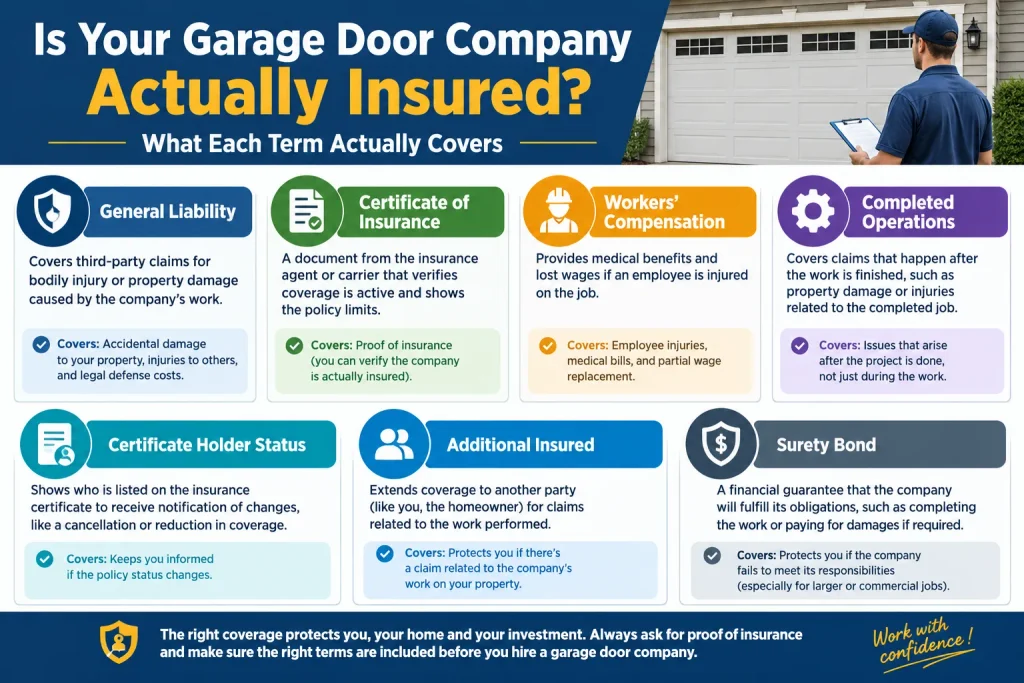
What Each Term Actually Covers
| Term | What it covers | What it does not cover | Verify by |
| General liability | Damage to your car, walls, framing, and door during the work | Injury to the contractor’s own employees | Calling the agent for per-occurrence and aggregate limits |
| Certificate of insurance | Nothing on its own. It is a summary document. | Anything, if it is expired or altered | Requesting it from the agent, not the contractor |
| Workers’ compensation | Injury to the technician on your property | Property damage | Asking whether they are a subscriber or non-subscriber |
| Completed operations | Damage from work that fails after the crew leaves | Ordinary wear or unrelated later faults | Asking whether it is included and for how long |
| Certificate holder status | Your right to be notified of cancellation | Any damage by itself | Asking the agent to add you before the deposit |
| Additional insured | Extends the policy to cover you for claims from their work | Claims unrelated to the contractor’s work | Requesting it in writing on larger jobs |
| Surety bond | Failure to complete work or contractual violations | Property damage of any kind | Asking for the bond number and issuing surety |
The Short Version
Every term above resolves in a single phone call to an insurance agent, made before the work is scheduled rather than after something has gone wrong. The one question that does most of the work is simple: may I have your agent’s number. What comes back tells you more about a company than any badge on a website, and the industry itself has been urging homeowners to verify rather than assume, including through an International Door Association post on garage door scam activity.
At First Call Garage Doors, we give homeowners the agent’s contact information alongside the estimate, because in a state without a licensing board that is the verification that actually means something. If you are in Richmond, TX and want a written quote with the coverage details attached, request a free quote or call for same-day service. It is also worth reading about routine safety inspections that prevent accidents and how to protect your family and property around a garage door, since the best insurance claim is the one nobody has to file.
Frequently Asked Questions
2. Will my homeowner's insurance cover damage caused by a contractor?
Sometimes, and your insurer will then try to recover from the contractor. That process is far messier when the contractor turns out to be uninsured, and it can affect your own premium. This is the practical reason we tell homeowners to verify coverage in advance rather than trusting it.
3. Is it rude to ask a contractor for their insurance agent's number?
Not at all, and any reaction suggesting otherwise is itself informative. This is one of our most common conversations, and legitimate companies field the request weekly from commercial clients. The ask is routine everywhere except in the mind of a company that cannot answer it.
4. Should I pay a deposit before verifying insurance?
No. Verify first. Once money has changed hands your leverage drops considerably, and there is no reason a verification call cannot happen the same day you get the quote.
5. What if the contractor says they are bonded instead of insured?
Then they have answered a different question. A bond guarantees completion of work, not damage to your property, and bond amounts are usually much smaller than people expect. Ask again specifically about general liability.
6. Does a small repair really need an insured contractor?
The size of the job is a poor guide to the size of the risk. Some of the highest-risk work is quick: a spring change takes under an hour and is the job where injuries and damage most often happen. Our rule of thumb from the field is that anything involving springs, cables, or the opener mount deserves the same scrutiny as a full replacement.
7. How do I know a certificate of insurance is not fake?
You do not, which is the entire point. Certificates are simple documents that anyone with a PDF editor can alter. The only reliable verification is a call to the agent or carrier listed on the certificate.
8. What does garage door contractor insurance typically cost the company?
Enough that it shows up in pricing, which is part of why the cheapest quote is often the uninsured one. Rates depend on payroll, claims history, and coverage limits, so treat a bid that undercuts everyone else by a wide margin as a question worth asking about.
9. My contractor's policy expired mid-project. What now?
Stop work until it is reinstated, and document the date you learned about it. If you were listed as certificate holder you would likely have been notified, which is the practical argument for asking for that listing at the start.
10. Is an insured contractor automatically a good one?
No. Insurance tells you the company can absorb a mistake, not that it will avoid making one. Pair the coverage check with certification, complaint history, and a written itemized estimate. Coverage is a floor, not a recommendation.