
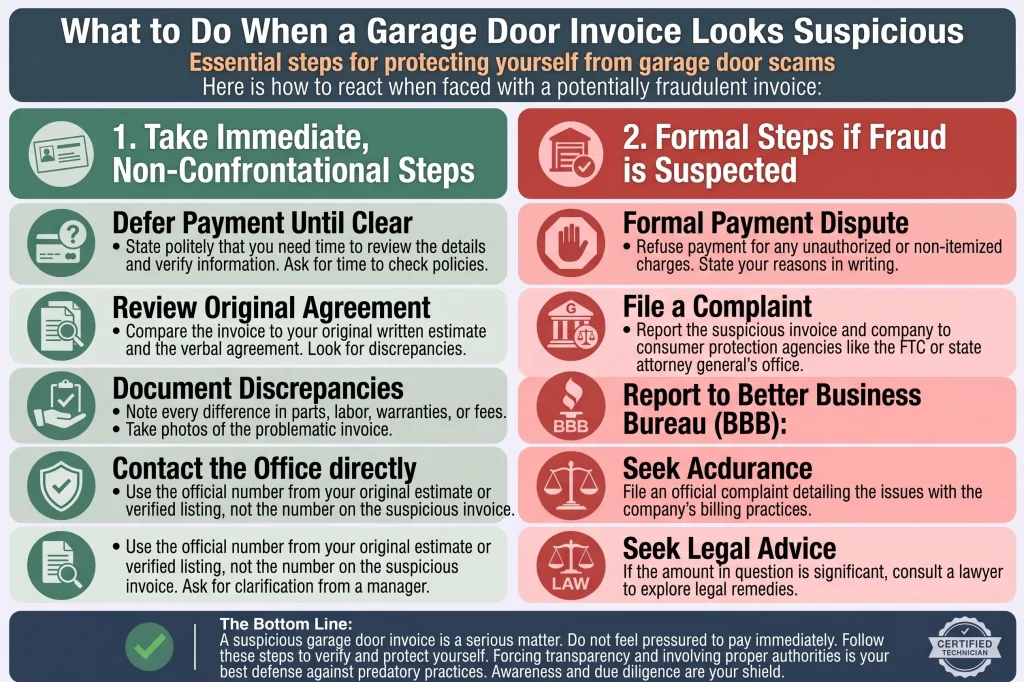
When a garage door invoice looks suspicious, pause payment, audit every charge, and verify the company. Acting immediately, while the technician is still present, puts the homeowner in the strongest position to resolve the problem before any money changes hands.
A calm, methodical response protects both the property and the wallet far better than an emotional confrontation ever could during the garage door repair visit. This guide walks through the exact sequence of steps to follow, including when a dispute needs to move beyond the driveway entirely.
Key Takeaways
- Never finalize payment until every charge is fully explained.
- Auditing the invoice against standard pricing exposes inflated part costs.
- Independently verifying the company confirms the technician actually works there.
- Calmly disputing charges protects the homeowner without escalating the situation.
- Reporting to the right agency protects future customers from the same scam.
Steps to Take When an Invoice Raises Concern
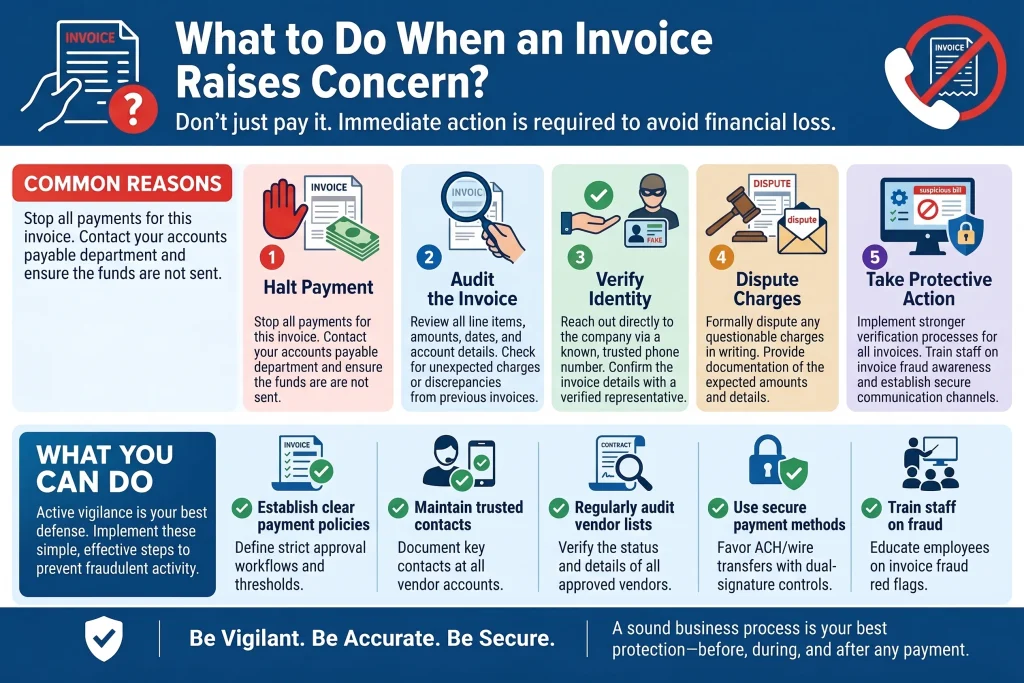
The response a homeowner chooses in the first few minutes after noticing a problem often determines how the entire situation plays out.
| Step | Immediate Action | Why It Matters |
| Halt Payment | Decline to pay or sign anything on the spot | Preserves leverage before money changes hands |
| Audit the Invoice | Compare charges against standard part pricing | Reveals inflated or invented costs |
| Verify Identity | Confirm the company through independent research | Rules out a fraudulent or unlicensed operator |
| Dispute Charges | Request justification calmly and in writing | Creates a paper trail for any later claim |
| Take Protective Action | Report the incident to the right authority | Prevents the same scam from repeating |
A homeowner who disputes a charge before confirming the company’s identity risks arguing with someone who may not even represent a real business.
Halt Payment and Secure the Property
The first move when an invoice raises concern is to stop the transaction completely before it becomes final and impossible to reverse.
These actions come first, before any conversation about the bill:
- Decline to pay until every charge is fully explained in writing.
- Refuse to sign the invoice or any completion certificate offered.
- Confirm that all keys, clickers, and remotes are returned immediately.
- Test the garage door personally before the technician leaves the property.
- Photograph the completed work before the technician packs up any tools.
To identify how a suspicious charge often connects to a larger pattern, read our guide on How Does a Garage Door Invoice Reveal a Scam, which breaks down the mechanism behind an invoice designed to pressure quick payment.
Audit the Invoice Item by Item
Auditing the invoice line by line exposes inflated pricing before it ever reaches a bank account or gets locked into a final payment.
A careful review should include each of these checks:
- Look up standard pricing for installed springs, rollers, or cables.
- Compare labor hours billed against the actual time spent on-site.
- Confirm that a charge for garage door replacement parts lists labor as a separate cost.
- Check for a service fee stacked on top of an already flat rate.
- Flag any part priced well above its typical retail cost.
To understand the specific overcharge patterns this kind of pricing often signals, read our guide on What Red Flags Appear on a Garage Door Invoice?, which covers the exact tactics scammers use to inflate a bill.
Verify the Company Identity
Verifying the company confirms the technician in the driveway represents the exact business you originally contacted for the job.
A homeowner can confirm this in several practical ways:
- Match the logo on the service vehicle against the printed invoice.
- Verify the physical address listed on the invoice.
- Watch for generic business names designed to sound legitimate.
- Call the official company number listed on its website, not the invoice.
- Ask the technician for identification tied to a real employee record.
Filing a consumer complaint becomes far easier once a homeowner has already confirmed these identity details in advance.
Dispute the Charges Directly
Disputing the charges directly, while staying calm, often resolves the problem sooner than any other single step.
A homeowner disputing charges should keep to this approach:
- Remain calm and avoid confrontation with the technician in the home.
- Ask for a specific justification behind every questionable charge listed.
- State a clear boundary, such as needing to review the bill first.
- Request the final invoice by email instead of a printed copy.
- Decline any payment method that leaves no traceable record behind.
Comparing the requested garage door service charge against a standard rate often reveals whether the dispute holds up.
Take Protective Action Afterward
Taking protective action afterward prevents a single bad experience from becoming a repeated pattern for someone else.
Homeowners can protect themselves and others through these steps:
- Contact a separate, reputable company for a second opinion on the work.
- File a complaint with the Better Business Bureau against the operator.
- Report the incident directly to a state consumer protection agency.
- Leave a detailed, factual review on Google, Yelp, or Nextdoor.
- Keep every document related to the repair, such as a garage door installation contract or receipt, for reference.
Comparing charges against standard scam-prevention information helps confirm whether the dispute reflects a broader, recognized pattern.
When to Escalate a Suspicious Invoice to a Formal Report
A dispute that remains unresolved after a direct conversation with the company strongly suggests formal reporting is necessary.
Homeowners reaching this point should take the following steps:
- File a written complaint with the Better Business Bureau immediately.
- Contact the state Attorney General or consumer protection office directly.
- Dispute the charge with the credit card company if payment already cleared.
- Report the license number to the local licensing board for review.
- Share the experience publicly to warn other homeowners in the area.
Escalating beyond a private conversation creates a formal record that protects both the homeowner and future customers of the same company.
A Suspicious Invoice Deserves a Clear, Calm Response
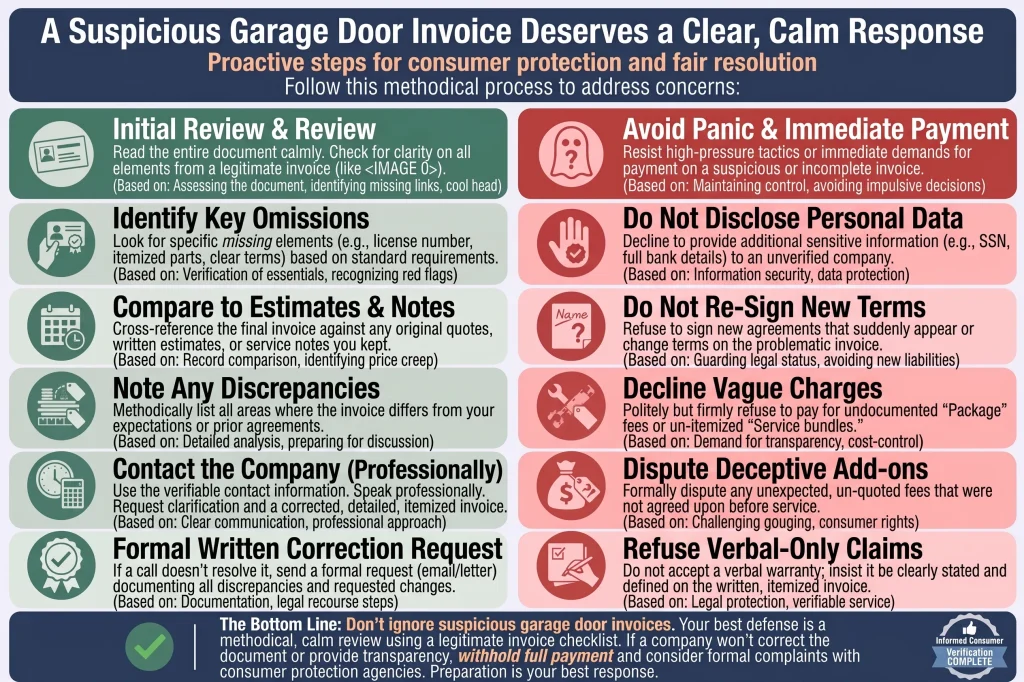
A garage door invoice that raises concern deserves a structured, methodical response, not a rushed decision made under sudden pressure from the technician. Following each step in the correct order protects the homeowner financially while leaving a clear, documented record if the dispute needs to escalate further.
First Class Garage Doors stands behind every invoice issued to homeowners across Los Angeles, CA, addressing any billing concern directly, honestly, and without delay. Contact us or give us a call today, and let our team resolve any invoice question before it ever becomes a larger dispute.
Frequently Asked Questions
What should a homeowner say if a technician becomes pushy about payment?
Stating a clear boundary, such as needing to review the payment terms with another household member first, is a reasonable and effective response. A legitimate garage door service provider will accept this delay without pressure or added urgency.
Is it safe to test the garage door before the technician leaves?
Testing the door before the technician leaves is one of the simplest ways to confirm the repair invoice matches work that actually worked as described. Do this step before you make any final payment or sign.
How does a homeowner know if a part price is inflated?
Searching standard retail pricing for the specific part, such as a spring or roller, usually reveals whether the invoice charge reflects a fair labor rate and individual costs. A price several times higher than the typical retail cost is a clear sign of overbilling.
What if the company address listed on the invoice does not exist?
An address you can't verify with a simple search is a serious warning sign that warrants immediate investigation. Homeowners should treat this discovery as grounds to pause payment and confirm the business details through other means.
Can a homeowner dispute a charge with their credit card company after paying?
Disputing a charge with the credit card company is still possible after payment, especially when the installation invoice or repair bill contains clear billing errors. This option works best when you file the dispute soon after the charge appears.
Should a homeowner get a second opinion before disputing an invoice?
A second opinion from a separate, reputable company helps confirm whether the original charges reflected fair pricing and necessary work at the job site. This step provides strong supporting evidence if the dispute needs to escalate further.
What information should be included in a Better Business Bureau complaint?
A complaint should include the company name, invoice details, invoice date, and a clear description of the specific concern. Attaching a copy of the invoice itself strengthens the complaint considerably.
Why does leaving an online review matter after a bad experience?
A detailed, factual review warns other homeowners before they schedule an appointment with the same company and creates a clear paper trail for others to reference. This step also creates a public record that can support a future complaint or legal action.
How long does a homeowner have to report a suspicious invoice?
Reporting a suspicious invoice as soon as possible strengthens the case and improves the odds of a favorable resolution. Waiting too long can make it harder to dispute charges or recover any future invoices or documentation needed later.