
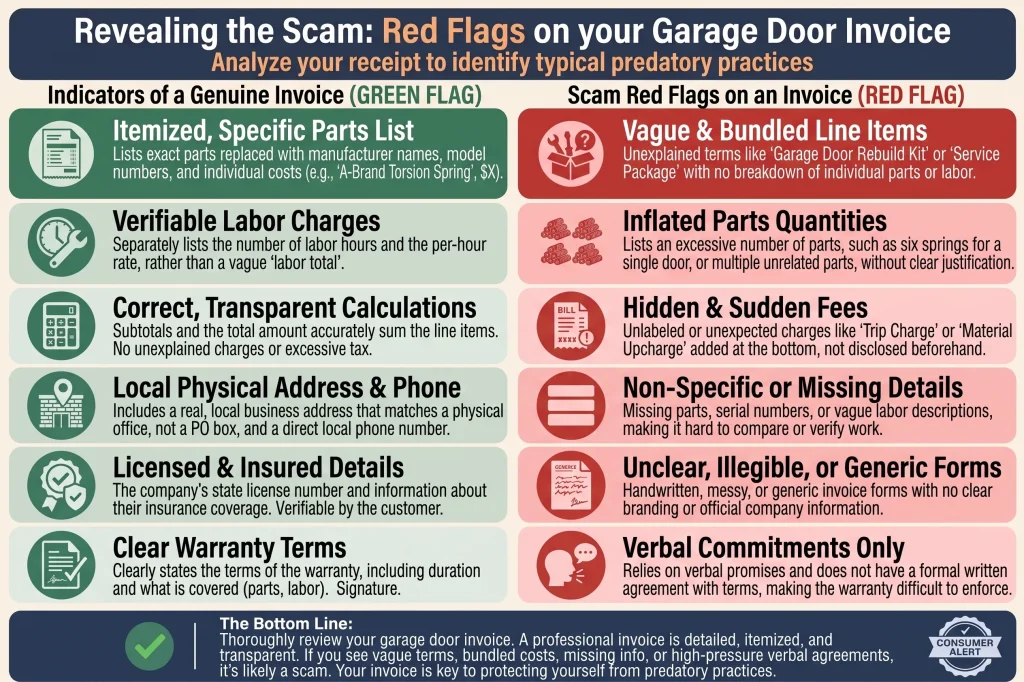
A garage door invoice reveals a scam through vague line items, missing company details, and a total that arrives rounded or rushed with no real breakdown behind it. Homeowners who know what a legitimate invoice for repair work includes can spot a fraudulent one within seconds.
Scammers rely on the fact that many people never look closely at an invoice until something already feels wrong during the garage door repair service call. Reading the paperwork with the same close attention you give the repair itself closes that gap before any payment is made.
Key Takeaways
- Legitimate invoices always list the company name, address, and a real phone number.
- Vague labor descriptions on a garage door invoice often hide inflated charges.
- A rushed or rounded total without itemization is a common warning sign.
- Homeowners should request a written invoice before paying.
- Reporting a suspicious invoice helps protect other homeowners from the same scam.
Traits of a Legitimate Garage Door Invoice
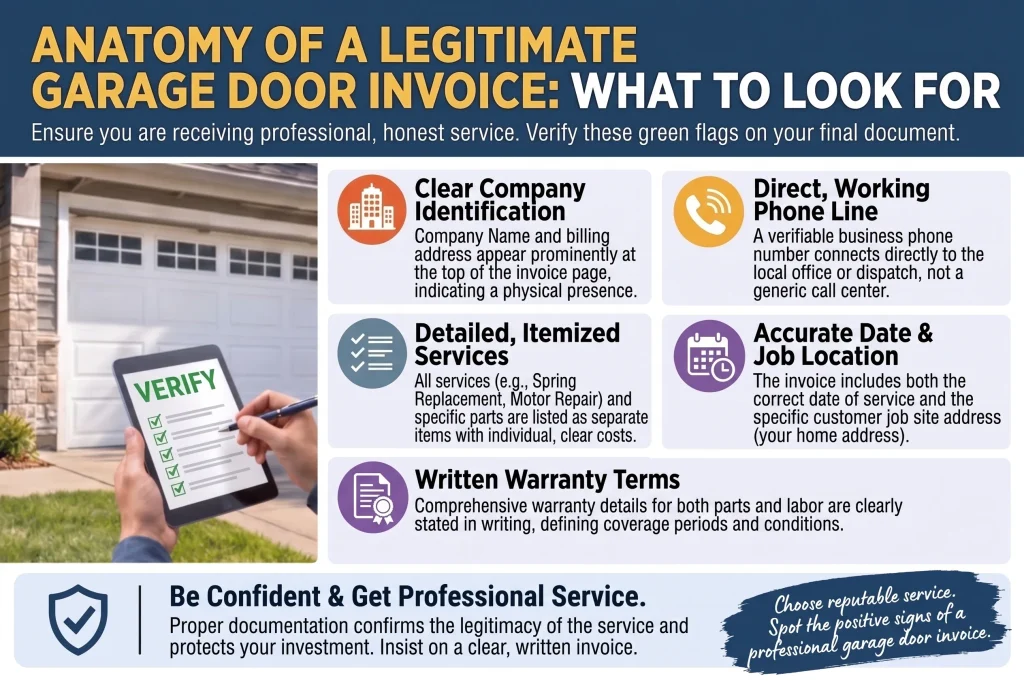
A trustworthy invoice reads like a clear, itemized record of the work actually performed, not a rushed demand for payment.
Legitimate invoices share these traits without exception:
- The company name and billing address appear at the top of the page.
- A working phone number connects directly to the business, not a call center.
- Invoice line items list parts and labor separately with individual costs.
- The invoice includes both the invoice date and a specific job site address.
- Warranty terms for parts and labor appear in writing, not spoken only.
To understand what should appear on paper before any payment is made, read our guide on What Should a Legitimate Garage Door Invoice Include?, which walks through every required field a homeowner should expect to see.
Signs That Point to a Scam Invoice
A scam invoice often looks professional and complete at first glance but falls apart under closer scrutiny.
Watch for these signs once the paperwork is in hand:
- No company name or business address appears anywhere on the page.
- The total amount due changes verbally after the invoice is already printed.
- Payment methods are limited to cash or app transfers with no card option.
- An unusually low service fee turns into hidden charges once the work begins.
- The technician cannot produce a phone number tied to a real dispatch office.
To identify the complete range of red flags before signing anything, read our guide on What Red Flags Appear on a Garage Door Invoice?, which breaks down every warning sign found in the line items themselves.
How Do Line Items Expose a Garage Door Invoice Scam
Legitimate operators price a repair the same way regardless of who’s in the driveway, with every part and labor charge traceable to the work actually performed.
| Line Item | What It Should Show | What a Scam Version Shows |
| Labor Description | The specific repair task and hourly or flat rate | A single vague phrase with no rate attached |
| Parts Used | The exact part installed, matched to the repair | A part unrelated to the actual work performed |
| Fees | Trip charge, dispatch fee, and permit fee listed separately | Fees folded into one unexplained lump charge |
| Total Calculation | A subtotal that adds up from every listed item | A rounded number with no visible math behind it |
| Payment Terms | Multiple payment methods clearly stated | Cash or app payment demanded with no alternative |
Nothing on a legitimate bill needs to hide behind a single lump figure once every line is traced back to the actual work performed on-site.
Vague Labor Descriptions Hide Inflated Charges
Labor charges written as a single unclear phrase give a technician room to justify almost any dollar figure.
A legitimate invoice breaks labor into specific, billable tasks instead:
- The description names the exact repair, such as spring or garage door cable work.
- The invoice clearly states the hourly or flat rate next to the labor charge.
- Labor time is listed in hours or fractions, not a single lump figure.
- Trip charge and dispatch fee appear as separate lines, not hidden totals.
- Overtime labor only appears when the job genuinely extended past hours.
Naming the exact task performed on a labor line leaves little room for a hidden markup to survive even a brief second look.
Missing Itemization Conceals the True Cost Breakdown
An invoice with one combined number for the entire job leaves no way to confirm that the pricing reflects real parts and real labor.
A proper service invoice includes this level of detail:
- Extension spring or torsion spring costs appear as their own line.
- Track realignment work gets billed separately from part replacement.
- Additional fees such as a permit fee are named individually, not bundled.
- Diagnostic fees are shown before any repair work begins on the door.
- The final invoice totals every listed item instead of one flat number.
Full itemization turns a single mystery number into a clear list that any homeowner can check directly against the actual repair performed.
Mismatched Part Numbers Signal Overbilling
A garage door invoice template that lists parts unrelated to the actual repair often means the homeowner is paying for work that never happened.
Genuine part entries should always reflect the job performed:
- Spring replacements match the actual garage door torsion springs installed on-site.
- Part costs align with standard pricing across the garage door industry.
- No safety upgrade appears unless it was discussed before work started.
- Additional requirements get explained before they appear on the bill.
- Warranty notes reference the exact part installed, not a generic label.
Comparing the listed parts against what was physically installed remains one of the fastest ways to confirm the bill is accurate.
Rounded or Rushed Totals Avoid Scrutiny
Payment collection often gets pushed hard the moment a total lands suspiciously close to a round number, chosen for convenience rather than calculated from real costs.
A few details make rushed math easy to identify:
- The subtotal before tax doesn’t clearly connect to the line items.
- Local rules on tax or licensing fees are left out of the total entirely.
- Payment collection is pushed before the homeowner can review the total.
- No breakdown separates labor time from total cost of parts used.
- The invoice arrives handwritten instead of through standard invoice templates.
Any total you can’t trace back to individual line-item charges deserves a careful second look before you use any payment method.
Duplicate or Padded Line Items Inflate the Bill
Billing the same task twice under different wording is one of the easiest ways an invoice hides extra profit inside a legitimate-looking format.
Reviewing each line against the actual repair prevents this:
- The same repair appears twice under slightly different descriptions.
- One diagnostic fee gets billed alongside a nearly identical service call.
- Labor spring replacement is billed separately from the spring installation.
- Parts already included in a flat rate reappear as their own charge.
- A trip fee is billed more than once for a single visit to the job site.
Cross-checking every line against the original work order remains the simplest, most reliable defense against a padded total.
Steps to Take After Suspecting an Invoice Scam
When an invoice looks wrong, the smartest move a homeowner can make is to slow down and think clearly instead of paying right away.
Homeowners who suspect a problem should take these steps immediately:
- Ask the technician to explain each line item before paying anything.
- Request a copy of the invoice by email in addition to any paper copy.
- Compare the listed company name against the number originally called.
- Decline app-based or cash-only payment methods if a card is refused.
- Contact the garage door service company directly using an independently verified number.
To understand exactly what to do once something on the bill does not add up, read our guide on What to Do When a Garage Door Invoice Looks Suspicious?, which covers the specific actions that protect a homeowner during the payment moment itself.
How to Report a Garage Door Invoice Scam
Reporting a fraudulent invoice does more than resolve one bad experience, since a documented pattern helps flag the same operator sooner.
A homeowner filing a report should follow these steps:
- Keep a copy of the invoice along with the vehicle and technician appearance.
- File a consumer complaint with the appropriate local licensing authority.
- Note the technician’s name and vehicle details for the written report.
- Dispute the charge directly with the credit card company if you used a card.
- Share the experience with neighbors to prevent a repeat visit nearby.
Reporting the incident through the proper channel turns a single bad invoice into a record that protects the next homeowner who receives the same pitch.
The Invoice Tells the Truth About a Garage Door Repair
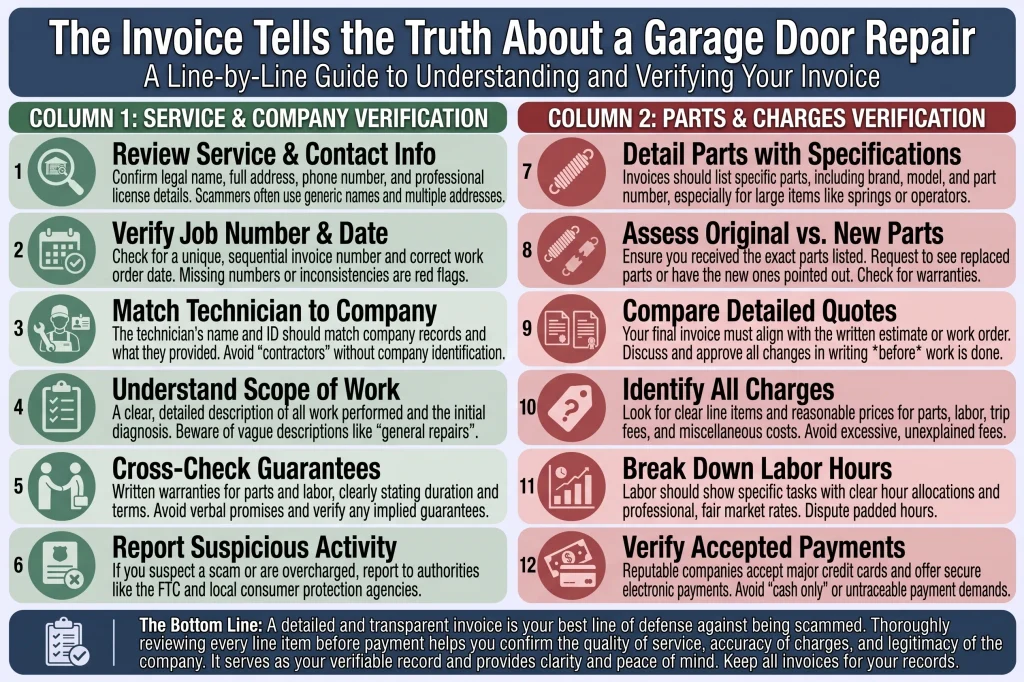
A garage door invoice tells the full story of a repair long after the technician has left the job site, and reading it closely is one of the simplest ways to avoid paying for work that never happened. The line items, totals, and company details on the page either confirm a fair transaction or reveal a pattern that no homeowner should ignore.
First Class Garage Doors works with homeowners throughout Los Angeles, CA, to make sure every invoice reflects the actual repair performed on the door, not an inflated or invented charge. Contact us or give us a call today, and let our team provide a transparent, itemized invoice for every completed repair.
Frequently Asked Questions
Is it normal for a garage door invoice to list a flat rate instead of an hourly rate?
Many garage door companies use a flat rate for common repairs like spring replacement, and this is a standard, honest practice. The key difference is whether the flat rate is explained clearly before the work begins rather than announced only afterward.
Why do some garage door invoices list a trip charge separately?
A trip charge covers the cost of dispatching a technician to the job site regardless of whether repair work is completed that same visit. Listing it separately keeps the labor and parts charges accurate and easier to verify against the actual repair.
Should a garage door invoice include a warranty in writing?
Warranty terms for both parts and labor should always appear on the repair invoice itself, not as a verbal promise from the technician. Written warranty information gives the homeowner real recourse if the same problem returns within the coverage period.
What does it mean if an invoice has no invoice date?
A missing invoice date makes it difficult to track warranty coverage and nearly impossible to dispute charges later with a credit card company. Every legitimate service invoice includes a date regardless of how the appointment was originally scheduled.
Can a homeowner request an itemized invoice after the fact?
Requesting a fully itemized breakdown remains possible even after the original invoice arrived in a vague or bundled format. A garage door repair invoice template often serves as a useful reference for what the revised version should include.
Why would a technician push for payment before providing a written invoice?
Pushing for payment before paperwork exists removes the homeowner’s ability to review costs or dispute charges after the fact. Garage door technicians at a legitimate company will always have a written invoice ready before finalizing any payment method.
Are online payment links on an invoice ever a red flag?
Online payment links are common among legitimate companies, but the link should always route to the actual business website rather than a generic third-party page. Verifying the link's destination before entering any card information prevents a common redirect scam.
What should happen if the total cost on the invoice does not match the verbal quote?
Address any mismatch between a verbal quote and the final total amount due at the service address before payment, not after the technician has left. A legitimate company will explain the difference in detail, while refusal to explain it signals a deeper problem.
How long should a homeowner keep a garage door invoice on file?
Keep invoices for at least the stated warranty period, and longer if any part of the job involved a permit fee. Keeping a digital copy on a phone or computer makes the record easy to retrieve if a dispute comes up later.