
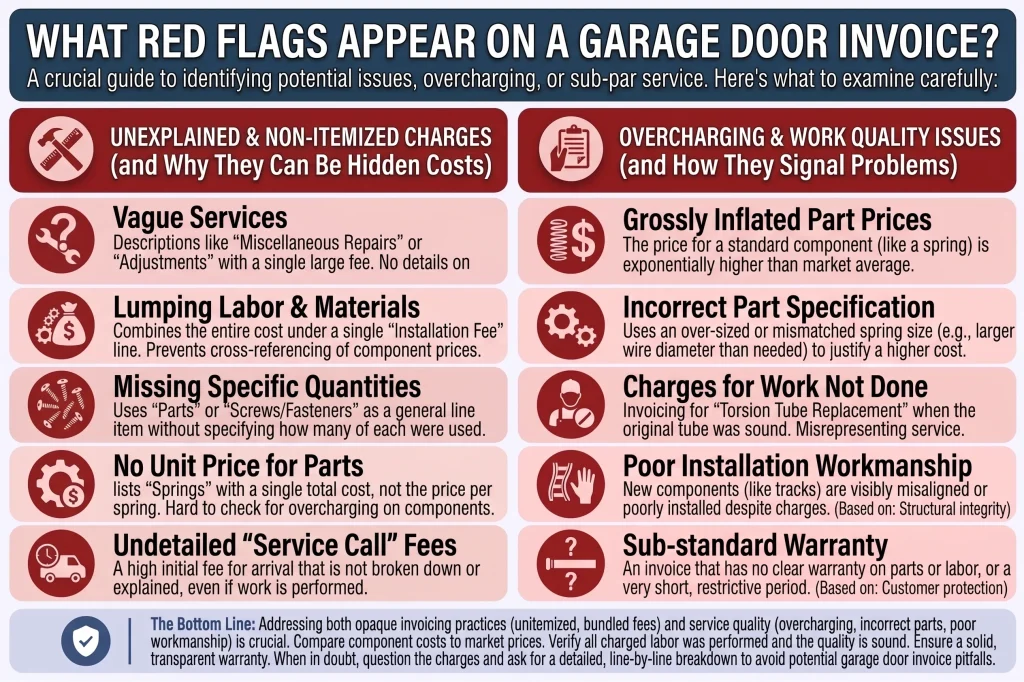
Red flags on a garage door invoice include surprise price increases, vague line items, unsolicited overhauls, warranty exclusions, mismatched payment requests, and missing business information. Homeowners who recognize these signs before paying can stop a fraudulent charge before it becomes a completed transaction.
A garage door repair technician using these tactics is betting the homeowner will accept each charge without asking a single clarifying question. This guide walks through each red flag in specific detail, along with the exact point where a suspicious invoice calls for a direct response instead of a signature.
Key Takeaways
- A final total higher than the written estimate deserves an explanation.
- Vague charges like miscellaneous fees often hide inflated or invented costs.
- Legitimate companies never request cash or personal payment app transfers.
- Missing business information makes it difficult to verify who performed the work.
- Warranty exclusions buried in fine print can lead to unexpected labor charges.
Red Flags That Signal a Problem on a Garage Door Invoice
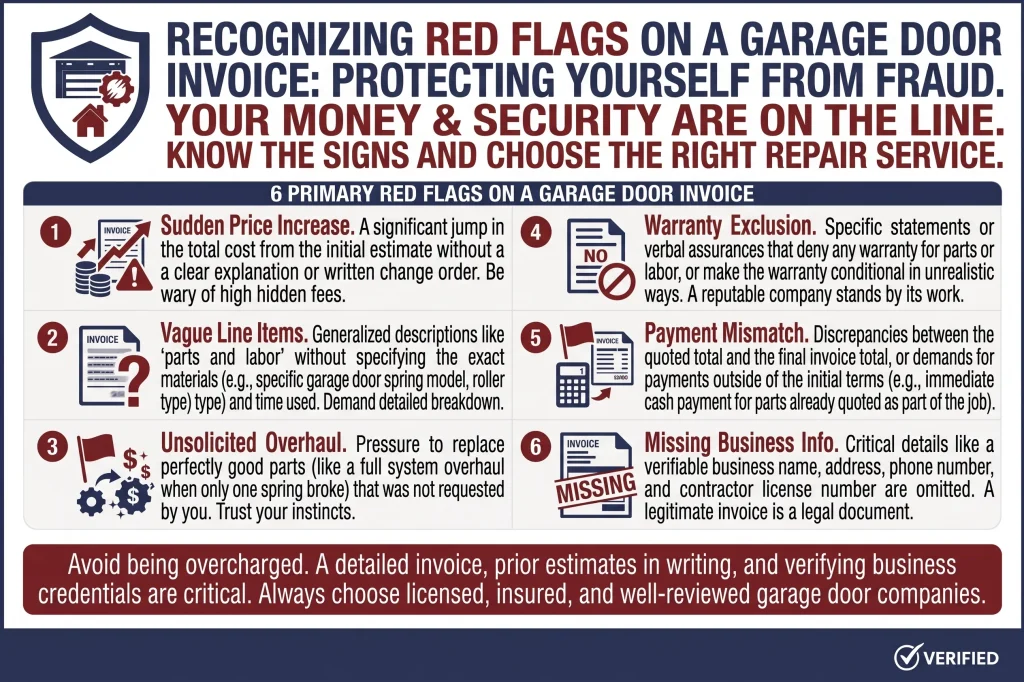
Scammers count on homeowners to accept their explanation at face value, without questioning whether the excuse makes sense.
| Red Flag | How Scammers Frame It | Homeowner Response |
| Price Increase | Presented as an unavoidable complication discovered mid-job | Request a written explanation before paying |
| Vague Line Items | Labeled as standard miscellaneous or extra labor charges | Ask for a specific breakdown of parts and hours |
| Unsolicited Overhaul | Framed as a necessary safety precaution | Compare against the original diagnosis |
| Warranty Exclusion | Buried in fine print the technician never explains | Request the original warranty documentation |
| Payment Mismatch | Explained as a business or accounting preference | Decline and request a traceable payment method |
| Missing Business Info | Left off entirely with no acknowledgment given | Verify the license and address independently |
Knowing the correct response ahead of time makes it much harder for a scam excuse to work once the conversation actually starts.
Surprise Price Increases Above the Written Estimate
A price increase without explanation is one of the clearest indicators that a verbal agreement is being ignored once work begins.
Watch for these specific signs of an unexplained increase:
- The final total exceeds the written estimate with no discussion.
- New charges appear that were never mentioned during the original call.
- The technician cites unexpected complications without documenting the details.
- No revised estimate is offered before the additional work begins.
- The technician never requests approval for the increase in writing or verbally.
To identify how this same pattern connects to a larger scam, read our guide on How Does a Garage Door Invoice Reveal a Scam, which breaks down why price increases often serve as the first visible sign of fraud.
Vague Line Items With No Real Breakdown
Vague invoice line items give a technician room to justify almost any dollar figure without ever naming the actual work performed.
These generic labels often signal a deeper problem:
- Charges appear as miscellaneous hardware with no specific part named.
- Extra labor is billed without stating the task or hours involved.
- Multiple repairs get bundled into a single unexplained flat charge.
- A charge appears as one lump sum with no garage door replacement parts or labor separated.
- The total cost changes verbally without a corresponding written update.
Homeowners who compare listed charges against known scam identification patterns will find vague billing language among the most frequently mentioned warning signs.
Unsolicited Overhauls and Unneeded Replacements
An unsolicited overhaul charges for a complete system rebuild or multiple part replacements that were never discussed or approved beforehand.
These charges often appear without any prior conversation:
- Multiple springs are replaced when only one showed signs of failure.
- Track replacement is billed without evidence of damage or misalignment.
- A full opener replacement appears despite a straightforward, minor issue.
- Additional hardware upgrades are added with no explanation provided.
- The homeowner never approved the expanded scope before work began.
Comparing the invoice with the original diagnosis is the fastest way to confirm whether the added work was necessary.
Exclusions Hidden Inside a Lifetime Warranty
A lifetime warranty sounds reassuring until the fine print excludes the exact part or labor charge appearing on the invoice.
These warranty exclusions often surface only after the repair is complete:
- Labor fees are charged separately even though parts remain under warranty.
- The warranty only covers select parts, not the ones actually replaced.
- Fine print requires garage door service records that were never mentioned upfront.
- The warranty excludes labor entirely, leaving the homeowner to pay the full cost.
- No original warranty documentation is provided to confirm the exclusion.
To address what to do once a warranty exclusion appears on the bill, read our guide on What to Do When a Garage Door Invoice Looks Suspicious?, which covers the exact steps for disputing an unexpected labor charge.
Mismatched Payment Details or Personal Payment Requests
A request to send payment to a personal name or a different business entity removes any real connection between the homeowner and the company originally contacted.
These mismatches often appear during the final payment request:
- Payment is requested through a peer-to-peer app to a personal account.
- The name on the payment request differs from the company name called.
- They request cash and offer no receipt for the completed garage door sensor repair or other service performed.
- No credit card or traceable payment method is ever offered.
- The technician discourages any payment method that leaves a paper trail.
Reporting a payment-related scam pattern helps flag the same tactic before another household encounters the identical request.
Missing Business Information or License Number
An invoice lacking a physical address, phone number, or license number leaves no reliable way to verify who actually performed the repair.
These missing details often appear together on a single invoice:
- No physical company address appears anywhere on the printed page.
- The listed phone number connects to a call center, not the business.
- A contractor license number is absent or cannot be verified locally.
- The company name on the invoice differs from the one originally called.
- No email address is provided for any follow-up communication.
To confirm which business details a trustworthy invoice should always include, read our guide on What Should a Legitimate Garage Door Invoice Include?, which walks through every detail a legitimate invoice should always contain.
What to Do When One of These Red Flags Appears
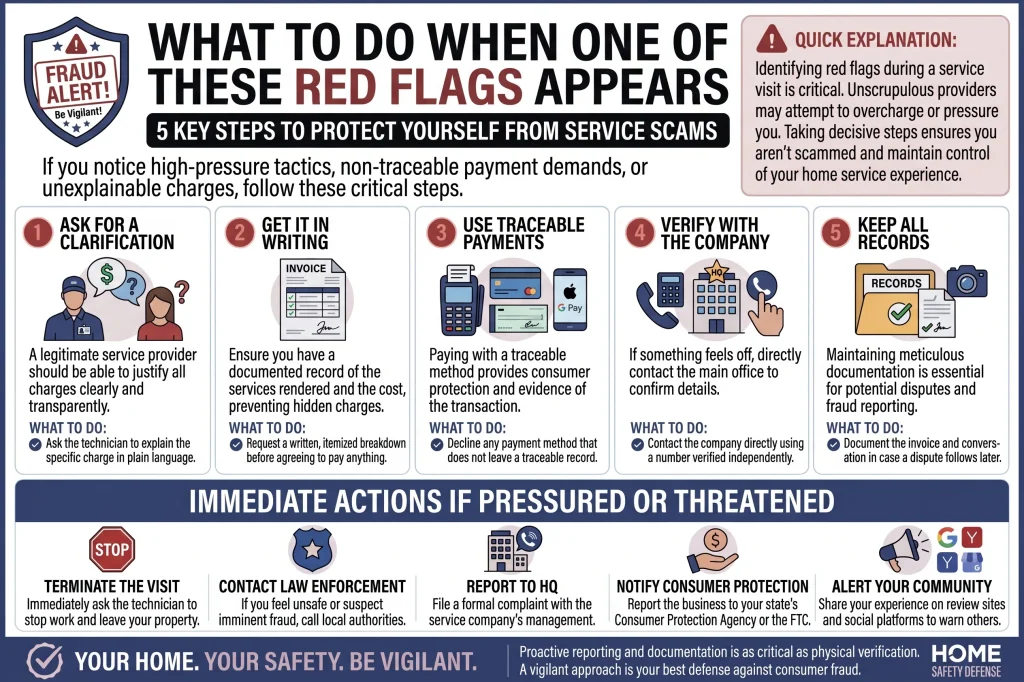
Homeowners who notice one of these red flags have good reason to slow down and ask direct questions before finalizing payment.
Steps to take immediately once a warning sign appears:
- Ask the technician to explain the specific charge in plain language.
- Request a written, itemized breakdown before agreeing to pay anything.
- Decline any payment method that does not leave a traceable record.
- Contact the company directly using a number verified independently.
- Document the invoice and conversation in case a dispute follows later.
Taking these steps in the moment often prevents a suspicious charge from becoming a completed, unresolved transaction.
A Red Flag Deserves a Question Before Any Payment Is Final
A garage door invoice with even one of these red flags deserves a direct, specific question well before any payment is finalized. Homeowners who recognize these warning patterns early can protect themselves from charges tied to work that was inflated, invented, or never actually approved in the first place.
First Class Garage Doors gives homeowners across Los Angeles, CA a fully transparent invoice with every charge explained before the appointment is considered complete. Contact us or give us a call today, and let our team walk through every line item with nothing left vague or unexplained.
Frequently Asked Questions
Is it normal for a garage door company to bundle multiple repairs into one charge?
Bundled charges are appropriate only when each repair is listed individually, with its own costs and labor hours shown. A single combined charge with no breakdown makes it difficult to confirm the pricing reflects the actual work performed.
Why would a technician suggest replacing parts that still work?
A technician suggesting unnecessary replacements may be attempting to inflate the final repair invoice beyond what the job actually required. Requesting a second opinion before approving additional work helps protect you from paying for parts you didn't need.
What does a warranty exclusion on an invoice usually look like?
Warranty exclusions often appear as a labor charge billed separately even though the part itself remains under full coverage. Homeowners should compare the invoice against the original warranty information before accepting the charge as valid.
Are peer-to-peer payment apps ever appropriate for garage door repairs?
Peer-to-peer payment apps sent to a personal name, rather than a verified business account, are generally not appropriate for professional repair work. A legitimate garage door service provider accepts traceable payment methods tied directly to the business itself.
Should a homeowner worry if the phone number on the invoice does not match the one they called?
A mismatched phone number is worth investigating before paying, since it may indicate a different entity is billing you for a different job site. Calling the original number to confirm the invoice details protects against a fraudulent charge.
How can a homeowner verify a company license number?
Contacting the local licensing authority directly is a reliable way to confirm whether a contractor license number is valid and current, especially before signing off on larger installation projects. This step takes only a few minutes and provides clear evidence before you finalize any payment.
Can a homeowner refuse to pay an invoice with major red flags?
Homeowners can decline to pay until the garage door installers or technician directly address every red flag. Documenting the concerns in writing, along with the invoice date, strengthens any dispute that follows if you withhold payment.
Why do scammers often push for immediate payment before leaving?
Immediate payment requests often prevent a homeowner from reviewing the invoice carefully or contacting the company to confirm the charges listed under the payment terms. Slowing down the payment process remains one of the most effective ways to identify an inflated bill.
What should a homeowner keep as evidence if an invoice looks fraudulent?
Homeowners should keep a copy of the invoice, any text or email communication, and photos of the completed work to maintain a clear paper trail. This evidence becomes essential if you need to dispute the charge with a bank or report it to local authorities.