
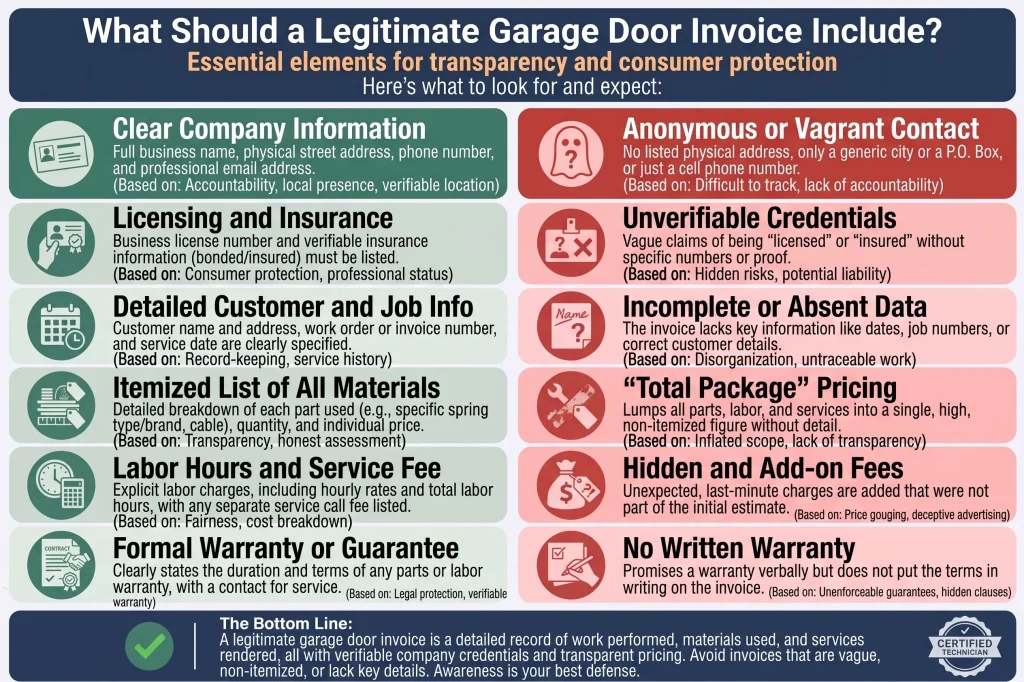
A legitimate garage door invoice includes business identification details, itemized parts and labor, invoice dates, financial totals, and written warranty terms. Homeowners who carefully confirm these elements before paying can avoid paying for work that was never performed.
An invoice missing even one of these fields can lead to disputes that are difficult to resolve after the garage door repair technician has already left the job site. This guide walks through every section a complete invoice should include, along with the point where a missing detail becomes a real reason for concern.
Key Takeaways
- A legitimate invoice always lists the company name, address, and phone number.
- Line items should separate parts, labor, and fees instead of one total.
- Invoice numbers and dates protect both the homeowner and the company.
- Warranty terms for parts and labor should always appear in writing.
- A signature line confirms the homeowner agrees the work is complete.
What a Complete Garage Door Invoice Should Include?
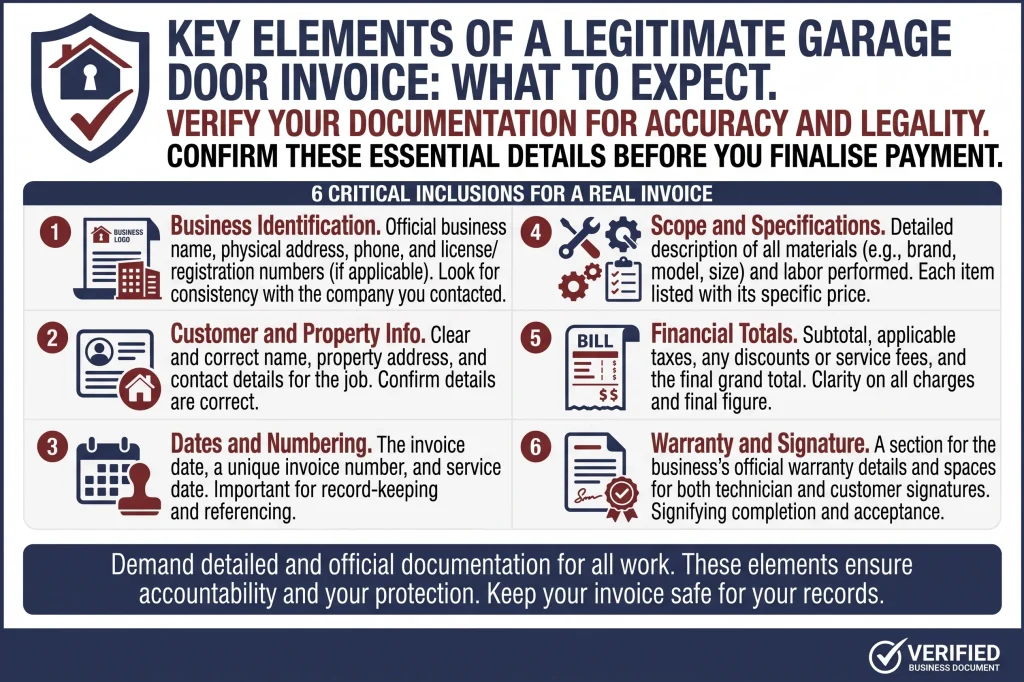
Legitimate operators treat the invoice as a full accounting of the visit, listing every part, fee, and hour worked instead of one unexplained total.
| Invoice Section | What It Confirms | Why It Matters |
| Business Identification | The company performing the work is real and reachable | Prevents disputes with an unverifiable business |
| Customer and Property Info | The service address matches the job actually performed | Confirms the invoice applies to the correct property |
| Dates and Numbering | When the work happened and in what sequence | Supports warranty claims and future reference |
| Scope and Specifications | The exact repair and parts involved | Rules out billing for work never performed |
| Financial Totals | How the final number was calculated | Prevents inflated or rounded charges |
| Warranty and Signature | Coverage terms and confirmation of completed work | Gives the homeowner recourse if problems return |
A homeowner who takes the time to verify this level of detail is far less likely to dispute the bill once the technician has already left.
Business Identification Details
Business identification confirms exactly which company sent a technician to the property, giving the homeowner a clear starting point for any dispute.
These details should appear clearly at the top of the page:
- The legal company name matches the name used during scheduling.
- Billing address appears alongside a working company phone number.
- An email address connects the homeowner directly to the business.
- Company logo appears if the business uses one on other materials.
- The invoice clearly lists a license, registration, or tax identification number.
To identify how this single detail becomes central to spotting fraud, read our guide on How Does a Garage Door Invoice Reveal a Scam, which breaks down the exact mechanism behind a missing or fabricated business identity.
Customer and Property Information
Customer and property information ties the invoice to the correct household and job site, which matters most on larger repairs.
An invoice should always include the following:
- Full client name matches the person who scheduled the appointment.
- Service address reflects exactly where the garage door installation or repair took place.
- Include the customer phone number for any follow-up communication.
- Include the email address for digital copies of the invoice.
- Secondary contact listed matches someone authorized to approve payment.
Confirming these fields early prevents confusion if a dispute arises weeks after the repair is completed.
Invoice Numbering and Key Dates
Invoice numbering and dates create a paper trail that becomes essential when a homeowner needs to reference the repair later.
An accurate invoice needs each of the following fields:
- Assign a sequential invoice number that has not been reused.
- Invoice date reflects when the document was actually generated.
- Service date matches the day the garage door opener or repair took place.
- The payment due date clearly states when the balance is expected.
- Deposit date is listed separately from the final payment date.
If homeowners file a consumer complaint later, they will need accurate dates to establish a clear timeline of events.
Scope of Work and Door Specifications
The scope of work connects the on-site diagnosis to every charge that later appears on the final invoice, giving the homeowner a clear reason behind each cost.
The invoice should describe the following in plain language:
- Summarize the reported issue before listing any repair steps.
- The diagnosis explains what caused the problem in specific terms.
- Describe the exact repair action taken, not vaguely.
- Note door specifications such as material, size, and insulation level.
- Clearly document modifications to the original door setup.
Recording the diagnosis alongside the repair prevents any confusion about what the payment actually covers once the invoice is reviewed.
Itemized Parts and Component Specifications
Component specifications separate a professional invoice from one built on vague descriptions, since exact measurements confirm the correct hardware.
Legitimate invoices include exact specifications such as these:
- List spring wire size and length for any garage door torsion spring repair.
- Specify roller type and size rather than describing them as generic parts.
- Include cable gauge and track specifications for related repairs.
- Document the opener brand, model, and horsepower for opener work.
- Every listed part includes a quantity, unit price, and total cost.
To examine how these same component details can also reveal a fraudulent invoice, read our guide on What Red Flags Appear on a Garage Door Invoice?, which covers the specific signs that parts information was fabricated or altered.
Labor Charges and Additional Fees
Labor and additional fees deserve their own dedicated lines, since combining every hour worked makes fair pricing difficult to confirm.
A complete invoice separates these charges clearly:
- Labor appears as either a flat rate or an hourly rate multiplied by time.
- List garage door service call fees on their own line.
- List diagnostic fees separately from any labor performed afterward.
- Note after-hours or emergency surcharges only when they apply.
- List old hardware disposal fees individually, not folded into labor.
Separating every fee this way confirms the homeowner pays only for the work and materials actually provided.
Financial Totals and Payment Terms
Financial totals bring every previous line together into one final number, and this is often where a homeowner catches an inflated charge.
This section should always include the following:
- Subtotal reflects the sum of every part, labor, and fee line listed.
- Calculate and show applicable taxes separately from the subtotal.
- Subtract any prior deposit or payment from the final total.
- List payment methods clearly, including any credit card options.
- State late-fee policies in writing if payment isn’t made immediately.
To address what to do when the final total doesn’t add up correctly, read our guide on What to Do When a Garage Door Invoice Looks Suspicious?, which walks through the exact actions to take when the numbers raise concern.
Warranty Terms and Signatures
Warranty terms and signatures close out the invoice, confirming both the coverage owed and the mutual agreement that the repair was completed.
These final elements should always appear together:
- List parts warranty terms with a specific coverage duration.
- List labor warranty terms separately from the parts warranty period.
- Signature line allows the homeowner to confirm satisfactory completion.
- Technician signature confirms the scope of work was fully performed.
- Include contact information for warranty claims near the signature line.
Comparing these terms against typical scam-prevention standards confirms whether the warranty language meets industry expectations.
How to Confirm Every Invoice Element Before Approving Payment
Confirming every element covered above takes only a few minutes at the end of the appointment, yet this final check prevents most disputes.
Homeowners preparing to approve payment should take these steps first:
- Compare the business name and address against the appointment confirmation.
- Check that every part and labor charge lists an individual cost.
- Confirm the service date and property address match the actual visit.
- Verify that warranty terms for parts and labor are both included.
- Ask for a corrected copy immediately if any section is missing.
Spending a few extra minutes confirming these details protects the homeowner long after the technician has already left the property.
A Complete Invoice Confirms a Fair and Documented Repair
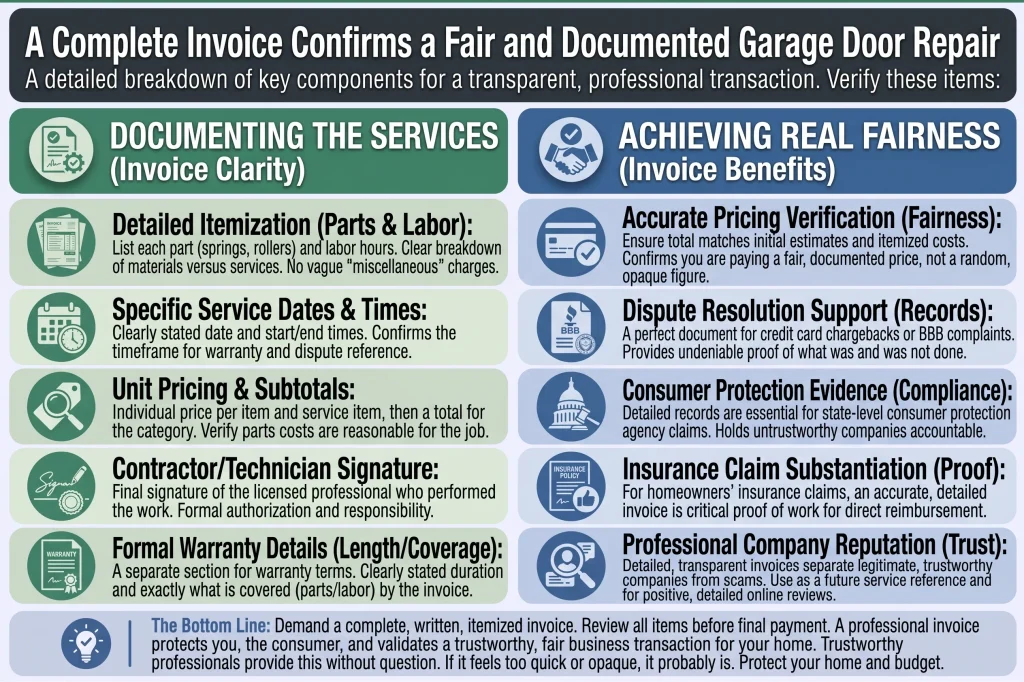
A garage door invoice that includes every required section gives the homeowner a complete, verifiable record of the repair performed, not just a simple request for payment. Reviewing each element carefully before approving payment turns the invoice into real protection, not a formality.
First Class Garage Doors provides homeowners throughout Los Angeles, CA with fully itemized invoices that account for every part, labor charge, and warranty term involved in the repair. Contact us or give us a call today, and let our team walk you through every line of the invoice before you finalize payment.
Frequently Asked Questions
Should a garage door invoice include the exact spring size installed?
An invoice listing the exact spring wire size and length confirms the correct part was installed, whether the job involved torsion spring replacement or an extension spring swap. Generic descriptions without these specifications make it difficult to verify the repair matches standard practice across the garage door industry.
Why does an invoice need a separate service date and invoice date?
The service date confirms when the repair work actually took place, while the invoice date confirms when the billing document was generated. A mismatch between these dates can confuse a homeowner later filing a warranty claim using information from the original service invoice.
Is it normal for a garage door invoice to list a deposit separately?
Listing a deposit separately from the final total is standard practice among companies that require partial payment collection before scheduling. The final invoice should always subtract this amount clearly through online payment or check, leaving only the remaining balance due.
What should a homeowner do if labor is not broken into separate lines?
Homeowners should request a revised invoice that separates labor time into either a stated flat rate or an hourly rate multiplied by hours worked. Combined labor charges without this breakdown make it difficult to confirm the pricing reflects the actual maintenance work performed.
Are disposal fees for old garage door parts a normal invoice item?
Disposal fees for old hardware are a normal and expected line item on many completed garage door repair invoice documents, similar to a standard garage door service invoice. These fees should always be listed individually, not combined into the labor or parts total.
Why does a signature line matter on a garage door invoice?
Signature lines confirm that the homeowner and garage door technicians both agree the work was completed to a satisfactory standard. Without this confirmation, resolving a dispute about the repair becomes much more difficult.
Can a homeowner request the opener model and horsepower on the invoice?
Homeowners can and should request this information whenever overhead door opener work is performed as part of the repair. Documenting the exact opener brand, model, and horsepower protects future warranty claims and any related purchase order.
What does it mean if warranty terms are not written on the invoice?
Warranty terms that exist only as a verbal promise offer little protection if the same problem returns after the appointment. Written warranty notes should always state the coverage period separately for parts and for labor, specifically for spring replacement work.
Should late fee policies always appear on a garage door invoice?
Late fee policies should appear in writing whenever you don't collect payment immediately at the time of service, along with any applicable permit fee, trip fee, or dispatch fee already billed. This detail protects both the homeowner and the garage door business by setting clear expectations before any balance becomes overdue.